Assembly of metallic nanoparticles into chains or plasmonic networks is affected by temperature and kinetics.


Assembly of metallic nanoparticles into chains or plasmonic networks is affected by temperature and kinetics.

Systematic insights into well-defined platinum-alloy nanoparticles promise cheaper and more-efficient fuel cells.
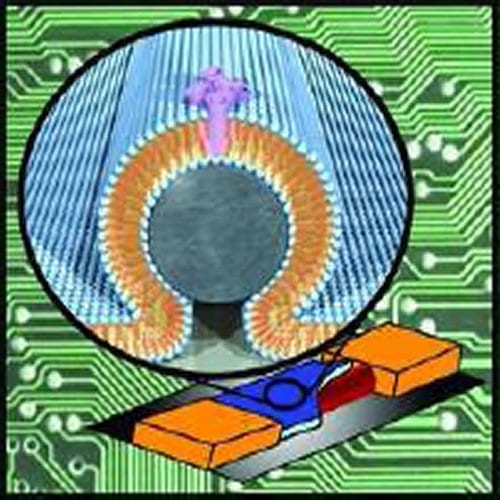
Science-fiction becomes science fact: How bionanoelectronics will revolutionize the world through medical and computational advances.
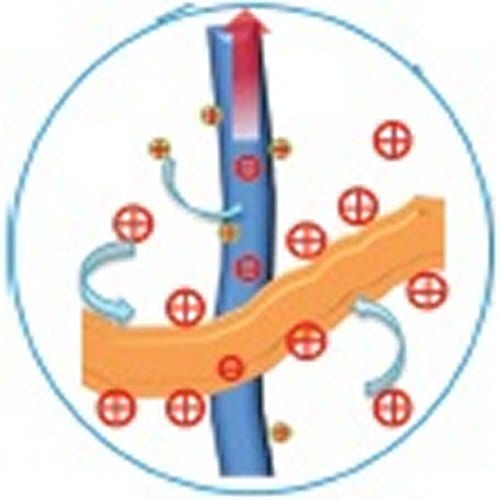
A supercapacitor with high power and energy density is made using nanocomposites containing carbon nanotubes.

Nuclease activity can be detected by a simple, sensitive, and selective test based on light scattering of carbon nanotubes, with no need for a label.
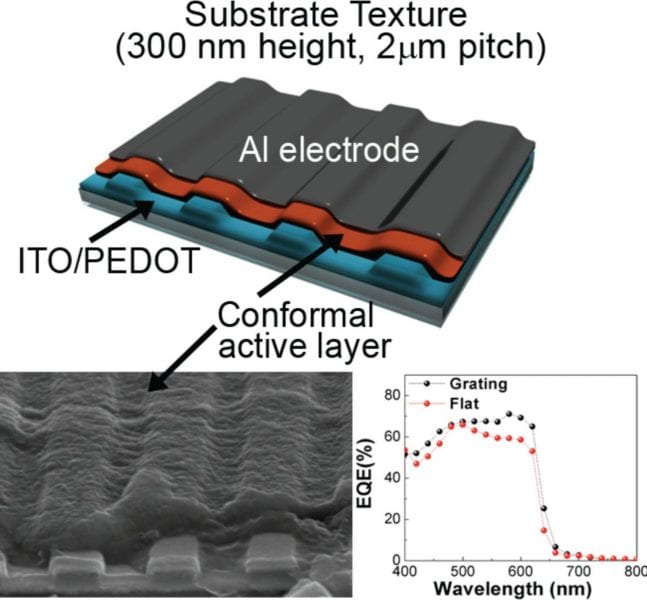
Sumit Chaudhary and co-workers from Iowa State University demonstrate that design optimization of the textured substrate leads to polymer-based solar cells that allow efficient light trapping without compromising the electrical characteristics.

Chinese scientists developed a temperature-sensitive drug release system based on titanium nanotubes. A smart hydrogel layer acts as controlling barrier and releases drug for local drug therapy.
A rigorous study by British and Irish scientists demonstrates a clear relationship between alignment and loading of nanotubes in nanocomposites and the nanocomposite mechanical properties.

A new 3D artificial extracellular matrix provides a combination of chemical, electrical, and mechanical cues to influence stem cell differentiation.
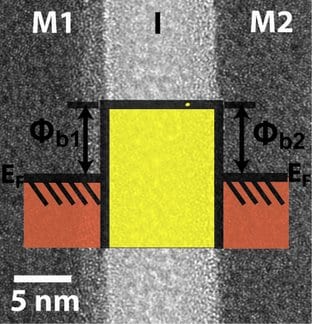
Researchers at Oregon State University develop cutting edge metal-insulator-metal diodes, harnessing quantum tunneling of electrons to increase performance of electronics.
 New theory suggests gravity is not a fundamental force
 Higgs boson may be driving the Universe’s expansion
 Water-powered gadgets may be on the horizon thanks to new evaporation-based energy device
 Scientists discover a new class of antibiotics
 Micron-sized hidden dimensions could solve two of physics’ deepest puzzles
 A new type of dark matter could explain mysterious radiation from the Milky Way’s core