
A team from ICMMO (Institut de Chimie Moléculaire d’Orsay) of Université Paris-Saclay recently showed that entropy-stabilized oxides can be substituted by aliovalent elements with charge compensation mechanisms.
Electronics
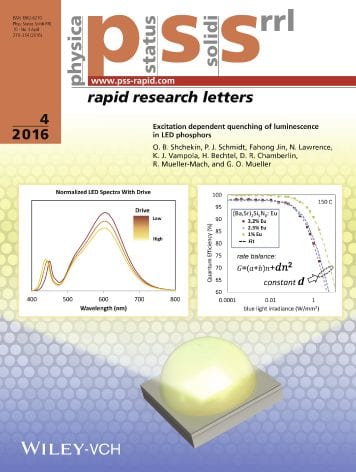
Droop in phosphors
Droop, the decrease of efficiency with drive, is a major technology topic for InGaN-based light emitting diodes (LEDs).
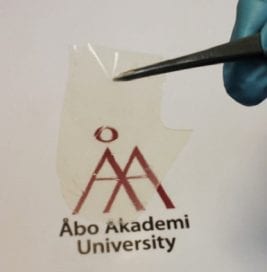
Ion-Gel Films for Organic Electronics
Ion-gels have possible applications in organic electronics due to their favorable electronic characteristics and good thermal and chemical stability.
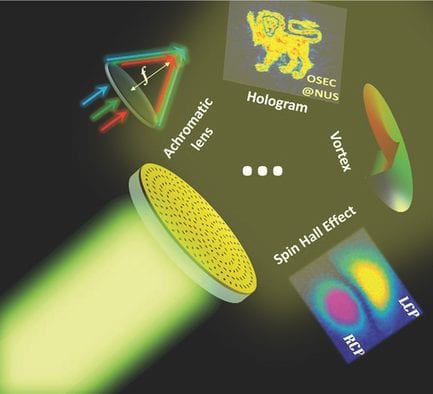
Advanced Optical Materials Top 5 – April 2016
The month’s top articles from the field of nanooptics, optoelectronics, optical devices, detectors & sensors, micro/nano resonators and more.
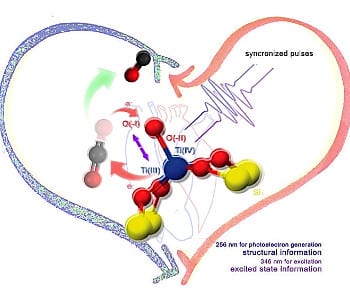
Titania mania – peering into the heart of photocatalysis
4D ultra-fast electron microscopy can peer into and peel away the most subtle details and beauty of photocatalysis, providing a new sharp focus realism of human-made nano machinery for the solar powered fixation of CO2 to fuels and chemical feedstocks.
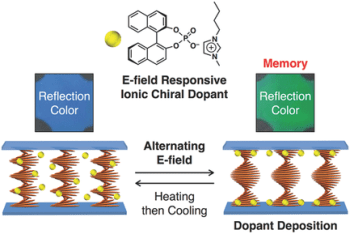
e-Papers now in color
One of promising candidates for the next generation display devices is electronic paper (e-paper).
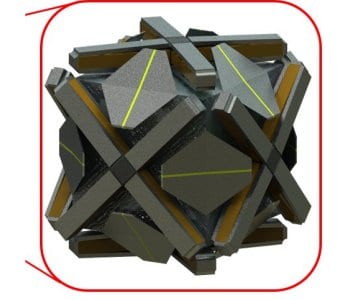
An Active Microarchitectured Material with Programmable Properties
Microarchitectured material that consists of small compliant unit cells that are independently controlled using piezo actuators, sensors, and microprocessors embedded within each cell.
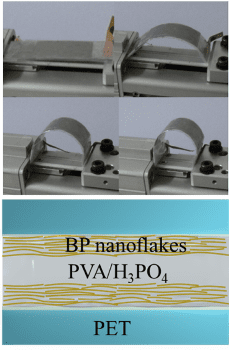
Black phosphorus unleashes the power of supercapacitors
Researchers in China build powerful and durable all-solid-state supercapacitors using black phosphorus nanoflakes.
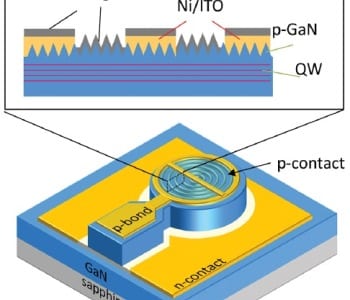
LEDs for Visible-Light Communications
Enhanced recombination rate is achieved on a novel plasmonic platform that exploits the spontaneous formation of a V-pit-texture on the surface of a light-emitting diode.
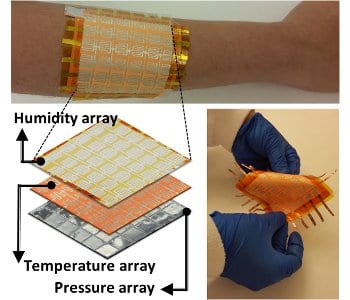
Sensitive skin – paper-based multifunctional artificial skin
Using only off-the-shelf components, researchers in Saudi Arabia have designed and built an affordable and multifunctional artificial skin sensor based on recyclable materials including paper and aluminium foil.
Popular
-
 New theory suggests gravity is not a fundamental force
-
 Water-powered gadgets may be on the horizon thanks to new evaporation-based energy device
-
 Micron-sized hidden dimensions could solve two of physics’ deepest puzzles
-
 Turning Periods into Power: Menstrual Blood a Valuable Resource for Medical Diagnostics
-
 Solar panels made of lunar dust could power a future Moon base
-
 Organic materials bring probabilistic computing closer to reality