Researchers from Chalmers University of Technology have shown that so called plasmonic metasurfaces, ultrathin nanostructured solid materials, can be used for reflective color displays if functionalized with conductive polymers.
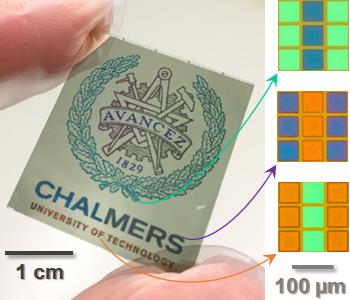

Researchers from Chalmers University of Technology have shown that so called plasmonic metasurfaces, ultrathin nanostructured solid materials, can be used for reflective color displays if functionalized with conductive polymers.
The month’s top articles from the field of nanooptics, optoelectronics, metamaterials, optical devices, detectors and sensors, micro/nano resonators and more.
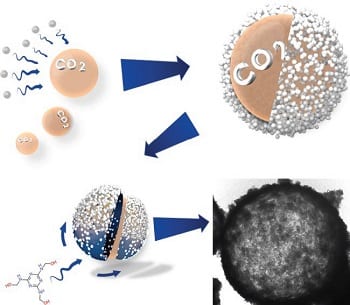
A new facile method has been developed where in situ generated CO2 gas bubbles are encapsulated in a nanoparticle stabilized emulsion.
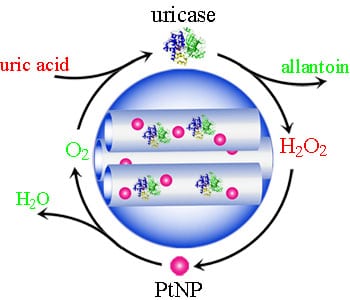
Professor Xiaogang Qu’s team engineered an artificial metalloenzyme for efficient and friendly ERT of hyperuricemia.
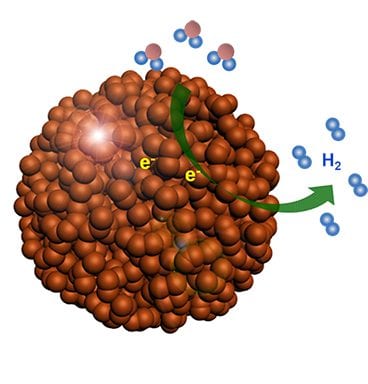
Researchers at the University of Science and Technology of China have developed mesoporous silicon nanospheres that can be used for photocatalytic hydrogen production.

This fuel-free fish-like deformable nanoswimmer is expected to advance rapidly towards practical biomedical applications.
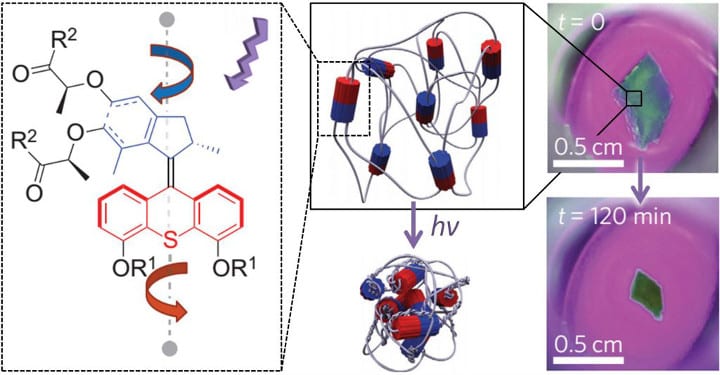
Modern chemical designers are often inspired by Nature as well as by man-made objects – think of the classical analogy between molecular building blocks and LEGO bricks, the lock and key principle, etc. This year’s chemistry Nobel laureates have certainly been inspired by a bit of both.
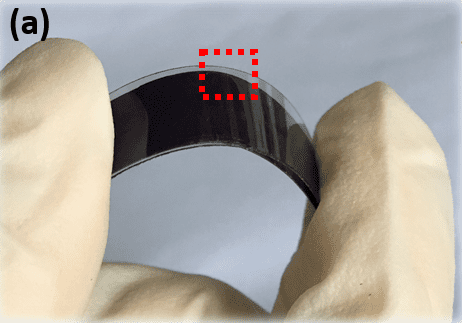
Scientists from Singapore and China have developed flexible titanium dioxide photoanodes with a multilayered structure.

Self-propelled Janus particles, acting as microscopic vehicles, have the potential of performing complex tasks on a microscopic scale.
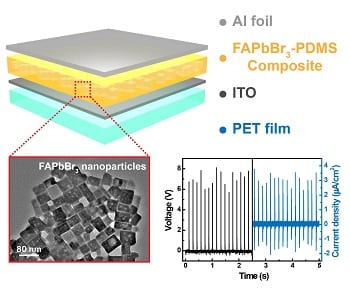
Ding and colleagues have fabricated a hybrid piezoelectric nanogenerator based on a composite of piezoelectric formamidinium lead halide perovskite (FAPbBr3) nanoparticles and polydimethylsiloxane (PDMS) polymer.
 Micron-sized hidden dimensions could solve two of physics’ deepest puzzles
 Turning Periods into Power: Menstrual Blood a Valuable Resource for Medical Diagnostics
 Surfactants Steer Supraparticle Structure
 Bone loss in obesity traced to gut microbiota
 Edible electronics realize safe, complex monitoring devices
 Quantum Anomalies in Condensed Matter: From Theoretical Peculiarities to Tangible Science