
Eric Betzig, Howard Hughes Medical Institute, Stefan Hell, Max Planck Institute for Biophysical Chemistry, and William Moerner, Stanford University, share award for the development of super-resolved fluorescence microscopy.
Biotechnology
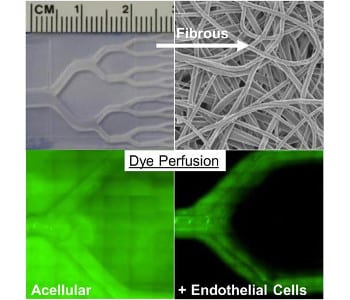
Microvascular electrospun scaffolds
A combination of 3D printing and electrospinning can be used for micropatterning fibrous scaffolds that are suturable, porous, and biodegradable.
Superhydrophobic nonwovens from naturally occurring polymers
a Japanese/German collaboration has succeeded in synthesising a biodegradable, hydrophobic polymer by modifying a naturally-occurring poly(amino acid) with a hydrophobic amino acid.
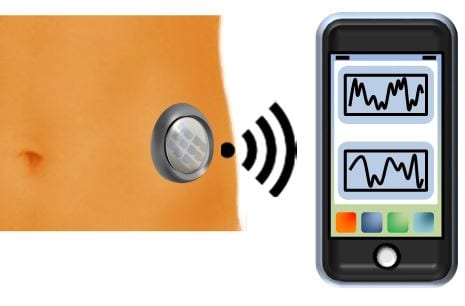
Tissue Implantable Insulin Sensors
A team from MIT explores the dynamics and operation of a hypothetical insulin sensor using a model for glucose, insulin and glucagon circulating in the body.
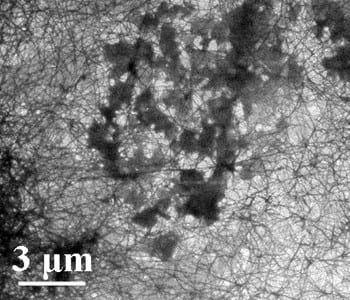
Hybrid electronic transport in peptides
Researchers show that ionic and electronic conduction occur simultaneously in self-assembled peptide nanostructures.
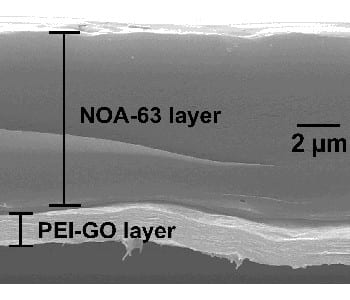
Improving on nature: light-driven biomimetic actuators
Researchers at Jilin University, China have reported the fabrication of low-power near-infrared (NIR) light-driven bilayer actuators.
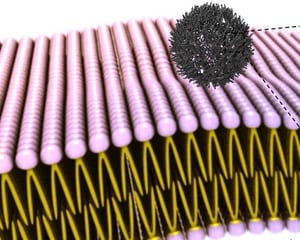
Microscopic switch shines a light on drug delivery
Researchers in Australia have developed a microscopic on-off light to help investigate how drug delivery systems interact with cells.
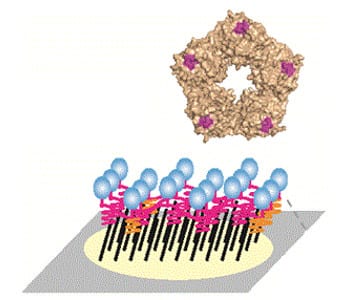
Mimicking inflammation with a biomimetic interface
An interface that models inflammation and infection will allow researchers to investigate biomolecular dynamics changes in local microenvironments.

Book review: Biomineralization Sourcebook
Professor Andreas Taubert reviews the Biomineralization Sourcebook: Characterization of Biominerals and Biomimetic Materials.
High-capacity battery uses only organic ingredients
American researchers design organic battery intended for deployment in power stations.
Popular
-
 New theory suggests gravity is not a fundamental force
-
 Higgs boson may be driving the Universe’s expansion
-
 Water-powered gadgets may be on the horizon thanks to new evaporation-based energy device
-
 Scientists discover a new class of antibiotics
-
 Micron-sized hidden dimensions could solve two of physics’ deepest puzzles
-
 A new type of dark matter could explain mysterious radiation from the Milky Way’s core