Researchers combine nanoplasmonic architectures and interferometry to bring nanoscale biosensors to near-commercial levels of sensitivity.
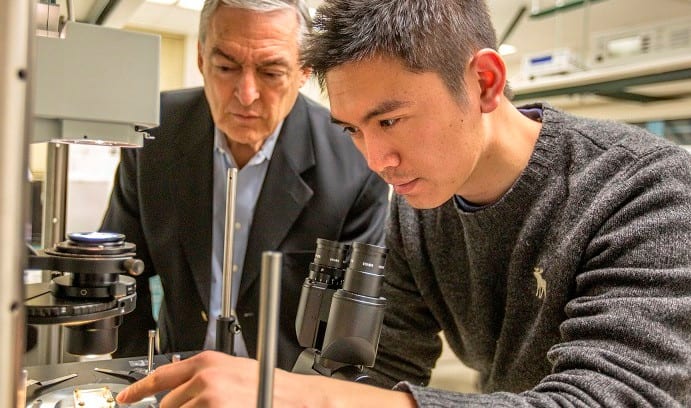

Researchers combine nanoplasmonic architectures and interferometry to bring nanoscale biosensors to near-commercial levels of sensitivity.
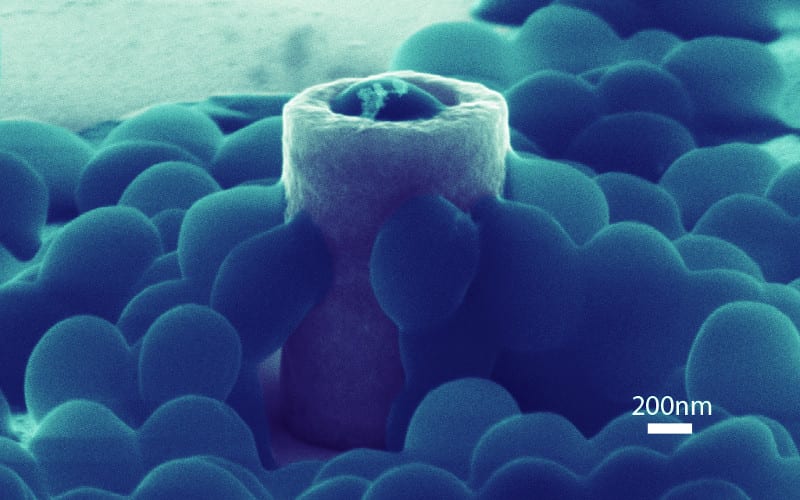
Berkeley Lab-led research could guide the development of bacteria-resistant materials.
Drugs used to treat blindness-causing disorders could be successfully administered by eye drops rather than unpleasant and expensive eye injections.
A new, quasi-solid-state electrode which is suitable for long term cutaneous recording has been reported by French scientists.

The German-based IPH is optimizing forging together with two other research institutes and four enterprises from five European countries.

SUNY professor Balaji Sitharaman reviews Nanomaterials in Tissue Engineering.

Professor Bengt Fadeel of Stockholm’s Karolinska Institutet reviews Nanomaterials for Medical Applications by Zoraida Aguilar.
A research team have coated biomaterial surfaces with a naturally expressed molecule that inhibit the inflammatory activation of immune cells.

Scientists create method to classify how cells are shaped in different environments.
Device made of organic transistor integrated with a human intestinal cell-line successfully detects Salmonella typhimurium.
 French WEST reactor breaks record in nuclear fusion
 New theory suggests gravity is not a fundamental force
 Quantum entanglement visualized for the first time ever
 An anti-inflammatory peptide may hold the key to low-back pain relief
 “Cosmic vine” discovered by the James Webb Space Telescope
 The Road to Better Presentation of Data: The Do’s and Don’ts
 Could a nuclear explosion set Earth’s atmosphere on fire?
 The dramatic story behind general relativity’s Nobel Prize snub
 Calculating the true environmental costs of AI
 Ibuprofen’s effect on red blood cells: A prickly affair