
A nanomaterial engineered by researchers at Duke can help regulate chloride levels in nerve cells that contribute to chronic pain, epilepsy, and traumatic brain injury.
Small
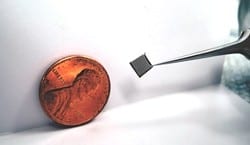
Glass fuel cells for next-generation electronics
New breed of micro fuel cell could serve as a long-lasting, low-cost, and eco-friendly power source for portable electronic devices.
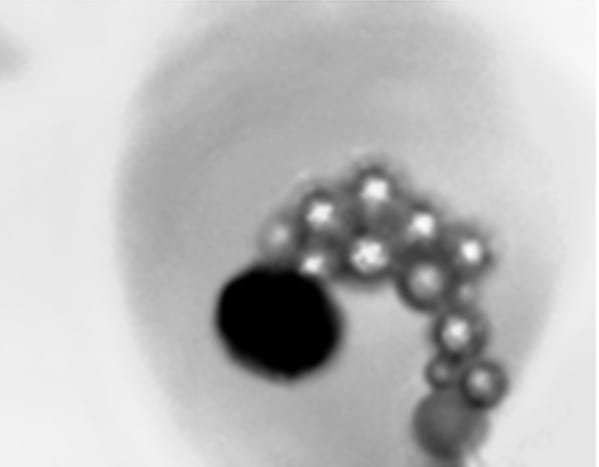
Micromotion Gets a Two-Faced Lift: Using Janus Particles for Chemical Power
Exploiting the two-faced nature of Janus particles leads to research in multi-fuelled locomotion.
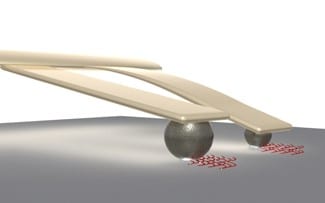
Researchers Develop New, Less Expensive Nanolithography Technique
Researchers from North Carolina State University have developed a new nanolithography technique that is less expensive than other approaches and can be used to create technologies with biomedical applications.
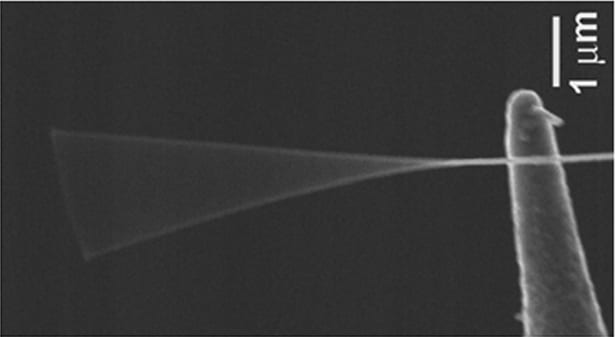
Precision Matters: Measuring Young’s Modulus
Clamping down a nanowire with a different material allows researchers to make more precise measurements of the nanowire’s Young’s modulus.
First Large-Scale Science Collaboration between China and Germany
Multilevel Molecular Assemblies: Scientists in China and Germany are working together to make efficient tools out of molecular assemblies.
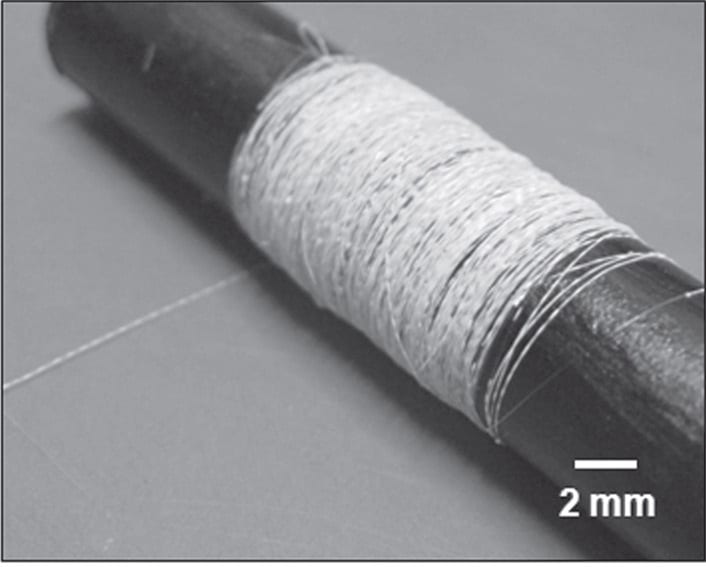
Surviving in the Wild with Silk: Collecting Water with Nanostructured Nylon
Scientists make artificial spider silk from polymer-coated nylon, which can collect water from the atmosphere with astonishing efficiency.
Stain Your Brain: Nanoparticles Enable Brain Surgery
Researchers at the University of Michigan have developed a new system that uses dye-loaded nanoparticles to tag brain tumors for removal.
Gel Shapes by Design: Patterned Surfaces for Cell Growth
Droplets can be designed in a specific shape and pattern, which could be used to control cell growth and movement as well as to make new nanocomponents.
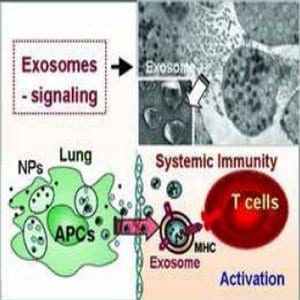
Trojan Horse Causes Nanoparticle Allergy
Workers with existing allergic conditions have worse reactions when exposed to nanoparticles, caused by a Trojan horse known as an exosome.
Popular
-
 New theory suggests gravity is not a fundamental force
-
 Higgs boson may be driving the Universe’s expansion
-
 Water-powered gadgets may be on the horizon thanks to new evaporation-based energy device
-
 Scientists discover a new class of antibiotics
-
 Micron-sized hidden dimensions could solve two of physics’ deepest puzzles
-
 A new type of dark matter could explain mysterious radiation from the Milky Way’s core