The properties of transparent glass sponges make them an ideal light source for photobioreactors for producing biofuels from algae.
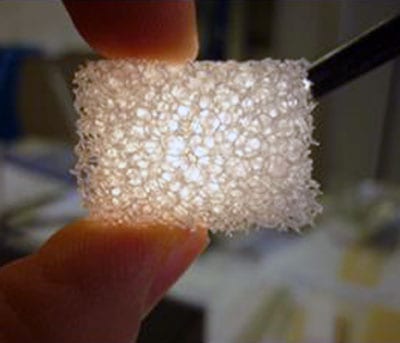

The properties of transparent glass sponges make them an ideal light source for photobioreactors for producing biofuels from algae.

Workers with existing allergic conditions have worse reactions when exposed to nanoparticles, caused by a Trojan horse known as an exosome.
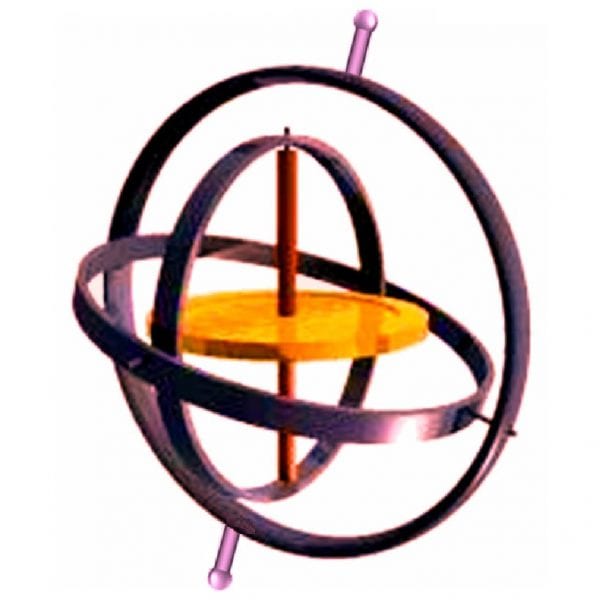
Specialized materials that do not change their volume with alteration of temperature may now be easier to produce, thanks to work into the mechanism of such behavior in antiperovskite manganese nitrides.
How do you stick a label on something as small as a cell? Cell-labeling techniques are explained, and the use of polymer-coated nanoparticles as environment-sensitive cell labels is demonstrated by scientists in Germany and Australia.
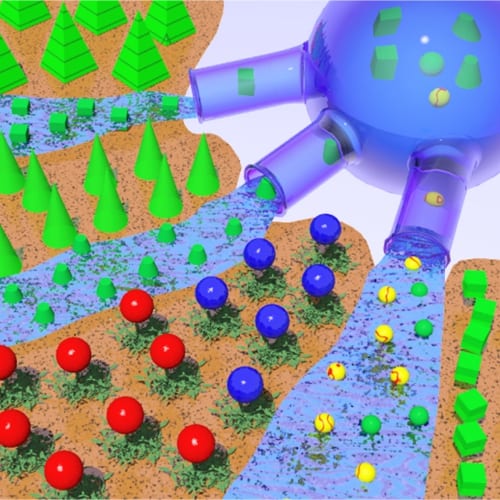
Professor Geoffrey Ozin discusses the safe and responsible development, production, use, transportation, and disposal of nanoparticles in existing or emerging nanotechnologies.
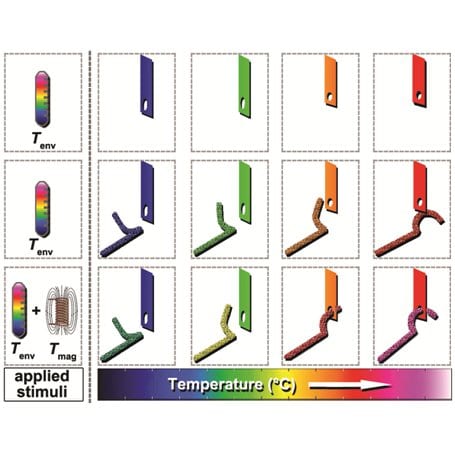
The development of materials with magnetically adjustable properties has been presented by a German research team from the Helmholtz-Zentrum Geesthacht (HZG) Centre for Biomaterial Development in Teltow.
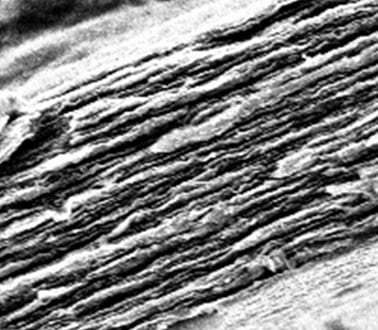
Researchers demonstrate electrochemical actuation using graphene-based paper.

MIT professor Mildred Dresselhaus takes a look at the latest work in fullerene chemistry.
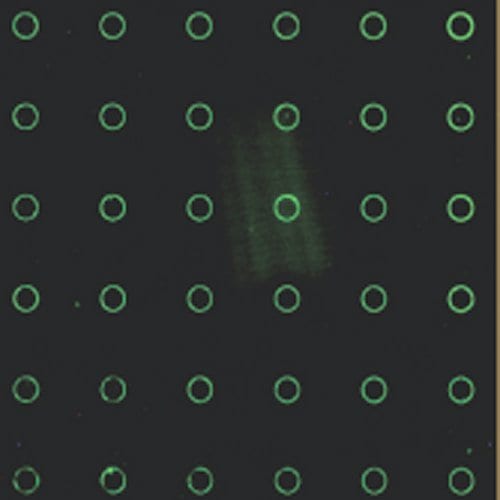
Ring-shaped arrays of DNA by using a simple self-assembly process driven by a balance of different forces, by scientists in the USA and S. Korea.

Surface patterning using conjugated polymers is set to take off, according to a review by Chinese scientists.
 New theory suggests gravity is not a fundamental force
 Higgs boson may be driving the Universe’s expansion
 Water-powered gadgets may be on the horizon thanks to new evaporation-based energy device
 Scientists discover a new class of antibiotics
 Micron-sized hidden dimensions could solve two of physics’ deepest puzzles
 A new type of dark matter could explain mysterious radiation from the Milky Way’s core