Researchers from Singapore and China review the use of computational modeling for a better understanding of 2D materials.
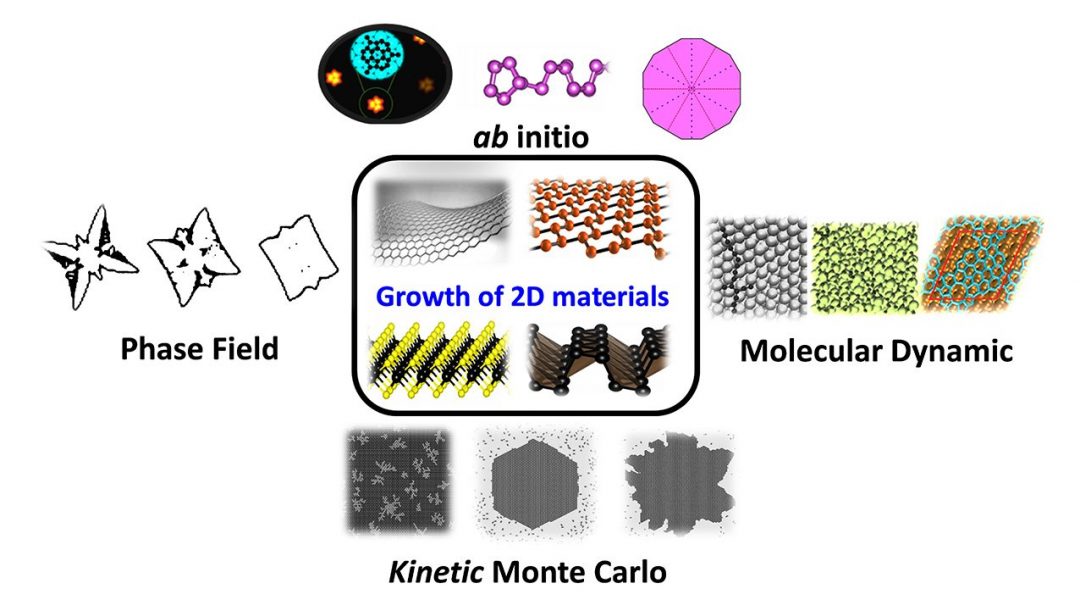

Researchers from Singapore and China review the use of computational modeling for a better understanding of 2D materials.

The theoretical background to confront head-on the problem of data assimilation together with several examples of practical applications is provided.

Bringing together leading quantum researchers to pave the way towards quantum-enabled devices in the near future.

New findings have the potential to vastly increase the functional capabilities of 3D-printed devices for industries such as electronics, healthcare and quantum computing.

American researchers designed a smartphone octo‐channel optosensor (SOS) for low‐cost low‐volume lab tests as a mHealth diagnostic tool.

DNA origami nanobiosensor: The binding of the bioanalyte (left) with the ssDNA-associated bioreceptor (center) on the surface of the DNA origami is transduced as a measurable change in properties (right) that can be recognized and quantified by a detector.

Self-healing of a phase change memory device with a metallic surfactant layer opens up new pathways in storage class memory.

An American team of scientists develop a novel phase stabilization technique with significant improvement in the phase stability of a micro-electromechanical (MEMS) vertical cavity surface-emitting laser (VCSEL) based swept-source optical coherence tomography (SS-OCT) system.

ANSYS presents promising digital exploration for product development with new simulation technology.

A new journal from the Advanced Materials family covering all aspects of theory and simulation in natural sciences is launching in early 2018.
 New theory suggests gravity is not a fundamental force
 Higgs boson may be driving the Universe’s expansion
 Water-powered gadgets may be on the horizon thanks to new evaporation-based energy device
 Scientists discover a new class of antibiotics
 Micron-sized hidden dimensions could solve two of physics’ deepest puzzles
 A new type of dark matter could explain mysterious radiation from the Milky Way’s core