
Lab wins three Federal Laboratory Consortium awards for energy storage, cancer treatment, and next-gen microchip work.
Results for "brain"
Carbon nanotubes lower nerve-damaging chloride in cells
A nanomaterial engineered by researchers at Duke can help regulate chloride levels in nerve cells that contribute to chronic pain, epilepsy, and traumatic brain injury.
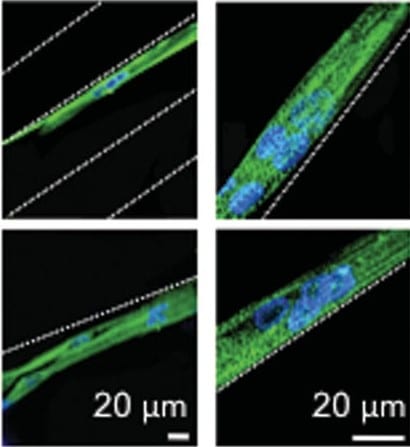
Models of Human Muscles from Protein-Engineered Biomaterials
Researchers have engineered a protein biomaterial to generate mimics of human skeletal muscle to study the effect of injury and disease on this tissue.
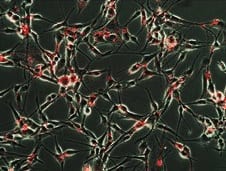
Quick and Safe Quantum Dots
Researchers at Rutgers University have developed a method to generate an entire library of safe quantum dots quickly and efficiently.
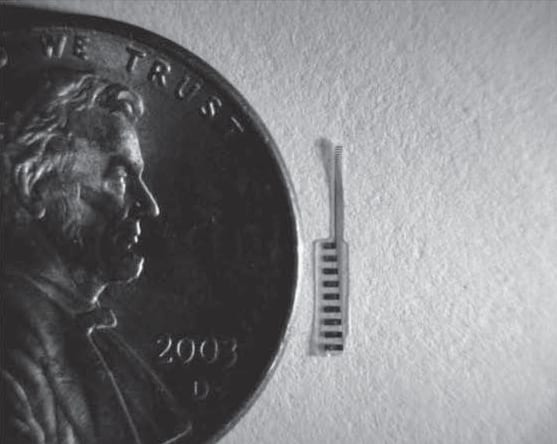
Processing Method Shows Promise for Neural Implants
University of Texas researchers develop materials that are stiff for initial implantation, and then soften to better match the mechanical properties of brain tissue.
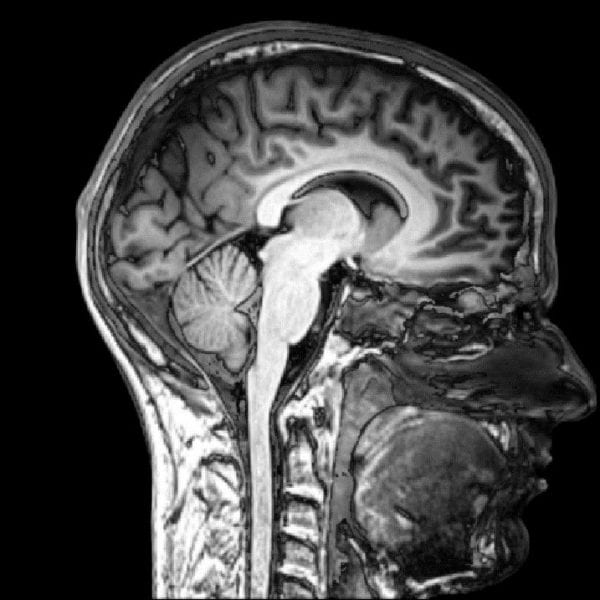
Comparing MRI Contrasts
Gossuin, Sandre, et al. describe the design of magnetic nanoparticles with optimised relaxivity for magnetic resonance imaging (MRI).
Teaching an Electronic Pavlov’s Dog: Memristive Devices in Neuromorphic Circuits
Researchers demonstrate learning in a memristive device.

Thinking Big about Small-Scale Research: Nanotechnology in Japan
The International Center for Materials Nanoarchitectonics (WPI-MANA) features in a new special issue from Advanced Materials.
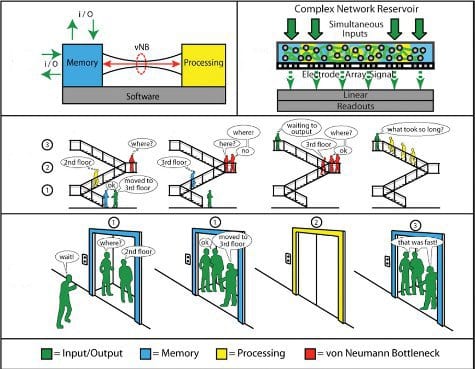
At the Edge of Chaos: A New Type of Computing
A computing network that exhibits emergent behavior similar to that in biological brains is hypothesized by Adam Z. Stieg of the California NanoSystems Institute
Teaching a New Dog, Old Tricks: Inorganic Devices Mimicking Biological Synapses
Biological synaptic behaviour related to short- and long-term memory creation is mimicked by inorganic devices.

Popular
-
 Micron-sized hidden dimensions could solve two of physics’ deepest puzzles
-
 Turning Periods into Power: Menstrual Blood a Valuable Resource for Medical Diagnostics
-
 Surfactants Steer Supraparticle Structure
-
 Bone loss in obesity traced to gut microbiota
-
 Edible electronics realize safe, complex monitoring devices
-
 Fermilab Confirms Muon g-2 Measurements