“Both biological and digital vision convert light into electrical signals through light-sensitive elements—the retina in the eye and image sensors in cameras,” write a research team from Italy led by Professor Thomas M. Brown (University of Rome Tor Vergata) in a recent Advanced Materials Technologies paper. Colour, brightness and contrast are all transmitted from those photosensitive elements to a processing unit to be turned into an image.
The difference is that biological environments are essentially wet, whereas technologies designed to replicate their functions tend to focus on solid-state components.
The new proof-of-concept ‘BIOPIX’ (bioinspired pixel sensor array) from Brown’s team blends the two, using sensors built from organic electronics within a biological liquid medium.
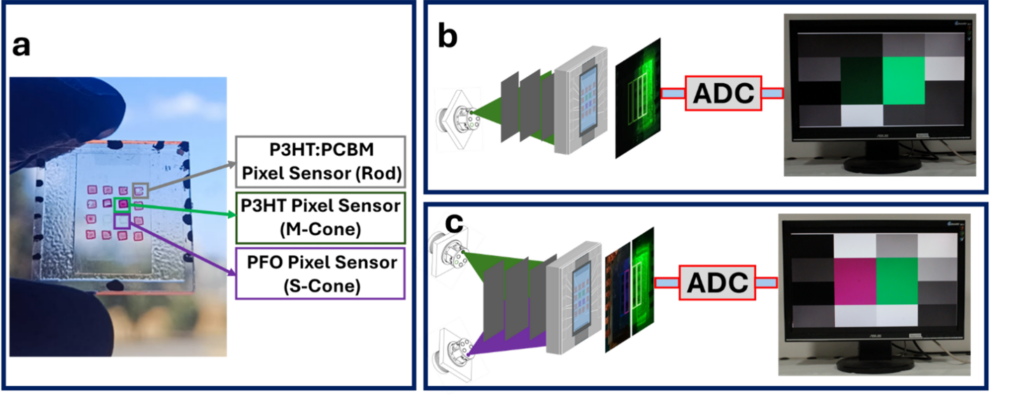
BIOPIX comprises a 2×2 sensor array that mimics the dichromatic, cone-mediated vision seen in mice plus a 4×4 array with rod-like polymer sensors to enable grayscale. The arrays are stencil-printed onto microelectrodes and encapsulated in Ames’ medium, a water-based liquid specially designed for use in retinal research, which functions here as the electrolyte.
“Fabrication of the arrays is easily scalable, and the resulting biocompatible device works at the interface between electronics and biology, capturing light and converting it into electrical signals in a way that more closely emulates the complex mechanisms involved in biological vision,” explains Ebin Joseph, post-doctoral researcher at Tor Vergata.
“By letting organic electronic materials interact with a liquid biological environment, BIOPIX reacts to light in a way that is much closer to how a real retina works in nature, both in how it senses colour (spectrally) and how quickly it responds,” adds Professor Brown. BIOPIX responds on the order of tens of milliseconds, mirroring the slower ionic dynamics of liquid-based mammalian retinas, and its sensitivity is comparable to that of established solid-state polymer semiconductor photodetectors.
The research team also connected their BIOPIX to a screen, for a first-ever demonstration of real-time ‘direct-to-display’ color image generation. “The challenge of converting light incident on BIOPIX into direct-to-display pixelated images was addressed by developing a dedicated electronic readout system tailored to its ionic liquid retina-like temporal dynamics,” explains Dr. Luca Di Nunzio, digital electronics and signal processing expert and a co-author on the paper.
“Confirming biocompatibility was a key step,” says co-leader of the study Prof. Antonella Camaioni from the Department of Biomedicine and Prevention of Tor Vergata. In vitro tests with human mesenchymal stromal cells validated the platform for further fundamental research and for future potential bioapplications: an artificial retina such as this one could one day help to restore sight when it becomes impaired due to disease or age-related macular degeneration.
So what lies ahead? “The BIOPIX retina emulator platform can, for example, be used to study new photoabsorbing artificial photoreceptor materials and physiological media prior to retinal implantation or injection, as well as to evaluate their performance under varying environmental conditions,” says Brown. “It can help understand differences in image sensing operating in fully solid-state mode versus that at the interface between biological (liquid) and semiconducting (solid) matter in a field where biology and technology are coming together to enable new possibilities.”
Adapted with permission. Original reference: E. Joseph et al., A Bio-Electronic Hybrid Solid–Liquid Pixelated Color Image Sensor Array as a Direct-to-Display Artificial Retina Emulator. Advanced Materials Technologies (2026), DOI: 10.1002/admt.202501461
Featured image credit: Clickerhappy via Pixabay