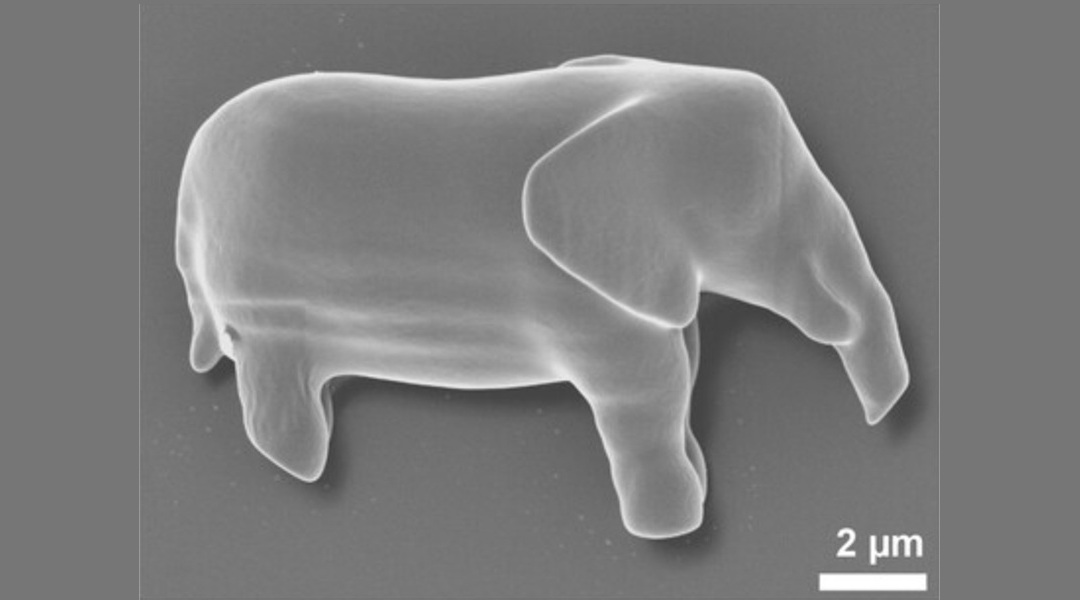
For the first time, researchers have 3D-printed tiny objects directly inside of living cells. These include an elephant a hundred times smaller than a grain of table salt, a barcode tag, and a working microlaser device.
This breakthrough opens the door to designing new tools to study cells from within. It also gives scientists unprecedented levels of control over the cell, allowing them to engineer cells with enhanced or even entirely new properties.
“Over the past decade, 3D printing has become an indispensable tool in industry and various scientific fields,” said Matjaž Humar, associate professor at the University of Ljubljana. “We are laying the groundwork for a new class of intracellular bioengineering tools and applications.”
Humar and colleagues used a 3D printing technique known as two-photon polymerization, where a liquid resin is made solid only in the specific locations where a very precise laser shines. The rest of the liquid is then flushed out, leaving behind a 3D-printed object.
With this method, it is possible to 3D print objects with a resolution of up to 100 nanometers, which is about two hundred times smaller than the average size of a human cell.
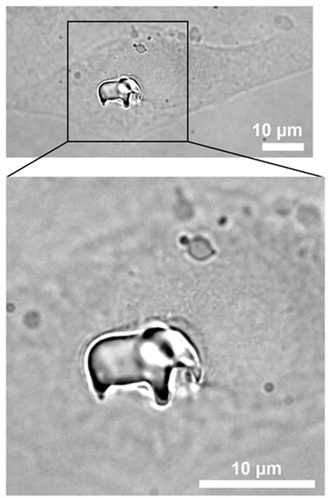
To make this whole process work inside living cells, the team had to find a resin that is not toxic to human cells and can dissolve away in water. First they injected a droplet of the resin into a human cell, then a laser printed the object directly inside the cell in less than 10 seconds. Most of the unused resin was dissolved and gone within two hours.
“One of the crucial parts of this study was determining the effect of 3D printing on the cells,” said Humar. Time-lapse images showed that cells containing 3D printed objects behaved normally. When they divided, the 3D print was passed on to one of the daughter cells.
Previous attempts had been successful at 3D printing objects inside synthetic cells, but never before within a living cell. Until now, objects had to be introduced into cells through microinjections, which often damage the cell. Other approaches leverage the natural ability of some cells to swallow up foreign objects, but not every cell can do this and items larger than one micrometer cannot be taken in this way.
In order to prove their method can print detailed objects within the cell, the team first designed and printed a 10-micron elephant figurine, complete with trunk and tusks. Then, they proceeded to 3D print a series of functional items with the goal of exploring more practical uses for this technique.
“There are many promising applications of printing within living cells,” said Humar. “One of the applications we explored is barcoding, where a foreign 3D object is used as an identification tag for a cell it resides in. By tagging them, the behavior of individual cells can be studied instead of the usual average responses obtained from large cell populations.”
The barcode system was designed to contain a four by four grid of cylinders, each of which could be empty or occupied. This resulted in more than a quintillion possible combinations, which is equivalent to the total number of grains of sand found on Earth’s beaches.
“This number far exceeds the number of cells in the human body,” noted Humar. “For real-life applications, much smaller barcodes could be used.”
Another application the team investigated was 3D printing functional microlaser devices, which could be used to probe individual cells from within. This was achieved by adding a fluorescent dye to the 3D printing resin. However, the dye proved toxic to the cells, causing 80% of them to die within a day.
This research could jumpstart a revolution in cell engineering, with potential applications extending well beyond barcodes and lasers. These could include 3D printing devices such as levers, springs, or barriers to modify the shape and behavior of the cell, or even control certain components within it. Microscopic sensors that respond to light, temperature, pH, sugar levels or magnetic fields could also be printed inside cells to study them up close. One day, scientists envision building microrobots inside cells.
Until then, more work will be needed to test the full potential as well as the limits of this 3D printing method. Going forward, Humar and colleagues are planning to develop resins especially designed for 3D printing inside cells, optimizing results while minimizing damage to the cells.
Reference: Maruša Mur et al., Two-Photon 3D Printing of Functional Microstructures Inside Living Cells, Advanced Materials (2026). DOI: 10.1002/adma.202519286
All images used for this article come from the above reference, 10.1002/adma.202519286, which was published open access and is free to read at the above link