Almost half of the world’s population have experienced car sickness and 12% are chronic sufferers. Rates are even greater in children, and, despite this high prevalence, there are very few effective treatments.
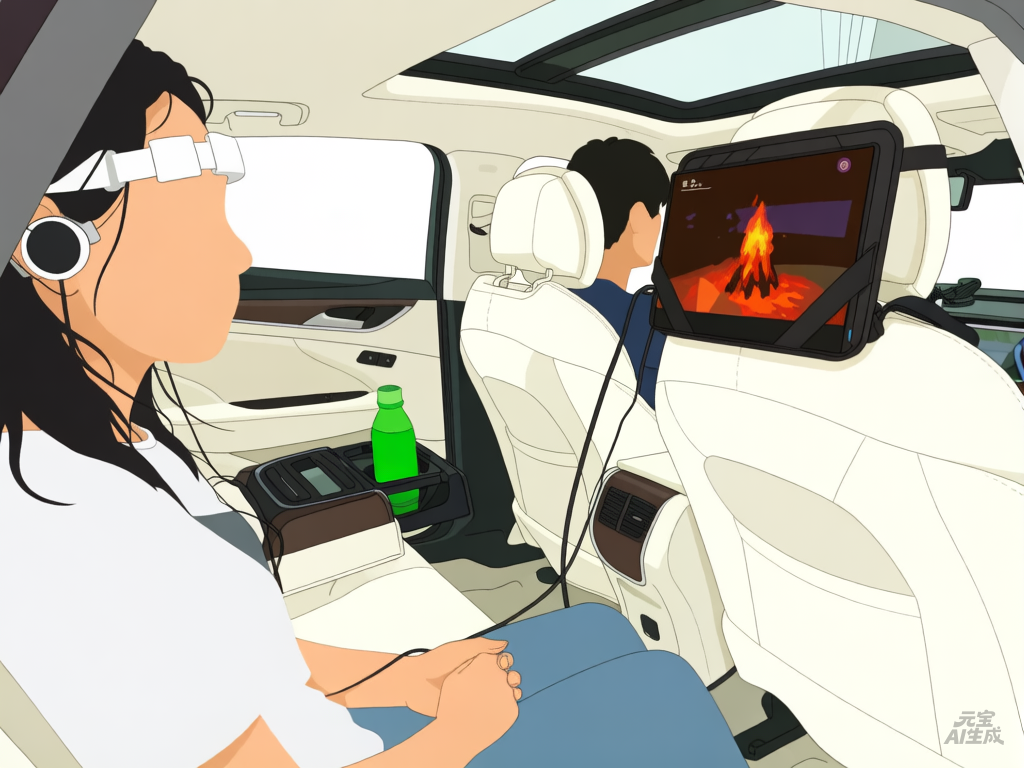
For the first time, scientists in China have developed a practical solution that brings together neuroscience, Brain–Computer Interface (BCI) technology, AI, and mindfulness to mitigate car sickness. Their wearable headband interprets electroencephalogram (EEG) signals and provides feedback, helping focus a person’s mind on mindfulness and shift their attention away from the moving environment.
“Our BCI-based attention-shifting method demonstrated notable effectiveness in substantially reducing car sickness symptoms across both short-term and long-term trip durations, particularly benefiting those with severe cases, as evidenced by real-world tests on over 100 susceptible participants,”explains Yuanqing Li, a Professor at South China University of Technology, Guangzhou, and senior author of the study.
Pathophysiology of car sickness
For hundreds of millions of people worldwide, the nausea, vomiting, dizziness and sweating due to car sickness is a regular and unpleasant experience. But what is car sickness, and why do some people suffer and others don’t?
During motion, the vestibular system located in our inner ear senses movement. The visual and auditory systems of our brains should also sense this movement but, in some people, these systems receive conflicting signals. When this conflict occurs and persists, a person experiences motion sickness.
The underlying neurobiological signatures (patterns of brain activity serving as biomarkers) for car sickness are poorly understood. This has hampered efforts for fully effective interventions: current treatments for car sickness are moderately effective medications with known side effects. Considering this and the high global prevalence of car sickness, there is a need for non-pharmaceutical solutions.
Yuanqing Li explains that attention-shifting methods are a promising option. The idea is that attention is shifted away from the moving environment and focussed elsewhere, to reduce the conflicting signals that cause car sickness. Commonly used examples such as deep breathing, counting or basic cognitive tasks are simple but only provide temporary distraction and are difficult to sustain.
“Moreover, most related studies on attention-shifting methods for preventing carsickness have been conducted in simulated and controlled laboratory environments,” Li notes. Thus, there is still a lack of effective non-pharmaceutical solutions tested and proven in a real-world environment.
To address this, the researchers in Guangzhou, China, performed a first-of-its-kind study providing insights into the neurobiological signature of car sickness and demonstrating how their novel device alleviates the condition.
A meeting of minds: Mindfulness and Science
Often through a focus on breathing, mindfulness meditation regulates s a person’s response to external stimulus and helps them to be in the present moment and free of distracting thoughts. Mindfulness-based cognitive therapy (MBCT) in mental health has increased significantly over the last two decades and shown to improve depression, anxiety, and stress symptoms.
Li explains the reasons for using mindfulness in their application: “Mindfulness meditation is a well-established cognitive training method. It can enhance attentional control and regulate one’s response to external stimulus, which aligns well with the needs in managing car sickness.”
But how can mindfulness be integrated with technology and science? The answer is through a brain–computer interface: a wireless headband detects EEG signals from the brain, which are interpreted in real time using AI. The AI output drives the visual feedback to the person through a computer, tablet, or phone.
“This assessment (which we call the “mindfulness score”) is fed back to the user through a dynamically changing audiovisual scene (e.g., the intensity of a campfire flame on the screen and the clarity of accompanying sounds change based on the level of focus). This allows the user to know if their mind has wandered and to immediately adjust, pulling their attention back to their breathing,” Li explains.
Over 100 people who suffer with car sickness took part in the study, which evaluated the device in short (two consecutive 20 minute) and long (two 120 minute) car rides. Both car rides consisted of a group using the device and a control group. Just over 83% of participants reported the device effectively alleviated their car sickness, particularly those with severe car sickness.
The closed-loop neurofeedback design is essential for its effectiveness, as proven in a separate cohort of participants where the control group used a sham system with random audiovisual feedback not based on their EEG readings. Just over 76% of those in the control group had no relief of symptoms.
But what is the neurobiological mechanism by which this works? Previous studies show beta power (the amount of brain waves in the beta frequency) is an EEG signature or pattern for carsickness.
“In simpler terms, the better people felt, the more this signature normalized. This direct link demonstrates that our BCI doesn’t just relieve symptoms but also modulates the brain activity pattern associated with car sickness, providing physiological proof of its effectiveness.”
Future directions
Pending further validation, the device offers promise of one day helping millions of car sickness sufferers worldwide.
Li says future studies will recruit more diverse populations across age groups and include controlled experiments to determine if other non-meditative attention-shifting methods are effective. The team also want to explore any long-term effects and whether, over time, the device can reduce a person’s susceptibility to car sickness.
But challenges lie ahead, as he explains.
“The main challenges include ensuring the device’s stability and reliability across diverse populations and vehicle environments; further simplifying the user experience to lower the barrier to use; and conducting larger-scale, multi-center clinical trials to meet regulatory requirements for medical devices, paving the way for eventual productization.”
If these challenges are overcome and the device gains approval, how accessible would the device be for people worldwide, including those in low-to-middle income countries? The device is highly portable and can be linked to a mobile phone, making it very accessible. Li says hardware costs are manageable and, if mass produced, could be further decreased, making it more affordable.
The scientists want to extend testing into other forms of motion sickness, such as seasickness and cybersickness. “Its core mechanism, alleviating sensory conflict by enhancing endogenous attentional control, theoretically holds potential for these scenarios as well,” Li remarks.
Reference: J. Zhu et al., A Wearable Brain–Computer Interface for Mitigating Car Sickness via Attention Shifting, Advanced Science (2026), DOI: 10.1002/advs.202513040
Featured Image Credit: the authors of 10.1002/advs.202513040