
Triboelectric nanogenerators (TENGs) are devices that use the triboelectric effect to generate electricity via the repeated sliding or tapping contact of two materials. The triboelectric effect is simply the phenomenon whereby electrical charge transfers from one surface to another during contact between the two materials (for example, when you rub a balloon against a woolly jumper!).
Although there have been triboelectric generators around for centuries (e.g., Franklin’s ingenious electrostatic machine of the 18th century), the TENG in its current form was invented in 2012 by Zong Lin Wang and co-workers.[1] The main innovation in 2012 was to use a relatively thin dielectric layer to induce charge on backing electrodes via electrostatic induction. With one electrode charged positive and the other negative, a current could then flow in the circuit connecting the electrodes, and power devices.
TENGs have a number of key advantages: they can be constructed very simply using inexpensive materials, they are efficient at low frequencies and they generate a higher power output than rival energy harvesters like piezoelectric and thermoelectric generators. Hence, there is now major global interest in using TENGs for two major purposes: as local energy harvesters to run low-powered sensors and devices and as self-powered sensors.
Prof. Daniel Mulvihill of the Materials and Manufacturing Research Group at the University of Glasgow started looking into triboelectric nanogenerators back in 2017. He recalls, “the main reason I got involved was due to my background in tribology (the science of surfaces in contact). It seemed to me, at the time, that the emerging TENGs had a lot of fascinating tribology that needed to be studied in order to understand and optimise them”.
In 2020, Mulvihill and his colleagues received funding from the UK Engineering and Physical Sciences Research Council (EPSRC) for a five-year project on ‘Next Generation Energy Autonomous Textile Fabrics based on Triboelectric Nanogenerators’ (Ref. EP/V003380/1). The project was in collaboration with partners at Heriot-Watt University in Scotland and with the Atlantic Technological University and Tyndall National Institute in Ireland. Since then, they have been working both on the fundamental mechanics and tribology of TENGs as well as their fabrication and applications – particularly in the area of textile TENGs for powering wearable sensors and devices, for example, pacemakers, heart rate monitors, fitness trackers, etc. In these cases, the energy input comes simply from everyday human movement (walking and running, etc.).
The majority of the global scientific effort has gone into material and electronic innovations to boost TENG performance, but one key aspect has been neglected: the way in which everyone tests these devices and reports the results. Without standards for testing and reporting – specific guidelines for how each type of test should be conducted and how the results should be reported – work from different teams and even separate studies from the same team may not be comparable, and therefore of limited use to drive this rich research area forward.
The latest fully open access paper from Prof. Mulvihill’s team addresses this problem by looking at the many issues surrounding the testing and characterisation of TENGs.[2]
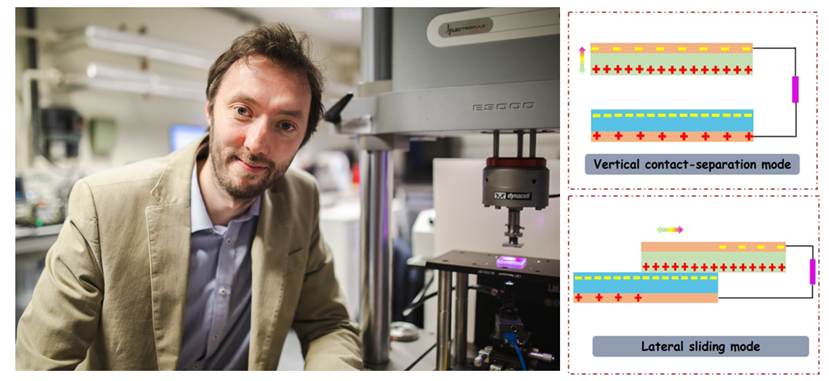
The paper acts, firstly, as a guide for practitioners on how to carry out testing. In the early years following the introduction of TENGs, testing was somewhat crude and underdeveloped, although a number of important testing innovations have now been made and these are collated in the paper.
It also addresses the important issue of standardising performance evaluation. It has become clear that triboelectric nanogenerator test results are sensitive to a very large number of factors (sometimes rather subtle), ranging from mechanical factors like surface roughness, surface alignment, contact pressure and contact area to environmental factors like temperature and humidity. If these factors are not accounted for, it can make it difficult to interpret results and compare results from different labs. An example involves two labs, A and B, testing a particular chemical surface intervention: if Lab A tests with even a slight surface misalignment, this can vastly reduce the magnitude of their electrical results compared to Lab B.
Providing a critical new perspective on standardisation, Mulvihill and his colleagues cover the main multidisciplinary aspects of fabrication, mechanical, electrical and environmental aspects of testing. For each phenomenon effecting TENG output, the key physics is explained with an accompanying discussion of the implications for TENG test results.
The authors also offer their thoughts on the ways in which each of these issues can be mitigated in testing or reporting. If care is taken to properly account for all factors during testing, accurate and comparable results can be achieved.
Prof. Mulvihill recalls that “the most exciting part of this work was bringing together our own experiences of TENG testing with fascinating observations scattered throughout the literature and collating it in one place, to address the multitude of factors effecting test results and produce a document that practitioners can refer to in designing more accurate and comparable tests”.
“We feel that researchers and practitioners will need access to standards in this area,” he observes. “Therefore, we note in the paper, that we would really like to see the establishment of a new committee of experts by the International Organization for Standardization (ISO) to look at developing new standards for the testing of energy harvesters such as TENGs.”
References:
[1] F.-R. Fan, Z.-Q. Tian, and Z.L. Wang, Flexible triboelectric generator. Nano Energy (2012), DOI: 10.1016/j.nanoen.2012.01.004
[2] D. M. Mulvihill et al., How to test triboelectric nanogenerators: key factors for standardized performance evaluation. Advanced Energy Materials (2025). DOI: 10.1002/aenm.202502920