Using plasmonic hotspots, gold nanostructures can be melted and made to produce the smallest nanojets ever observed.
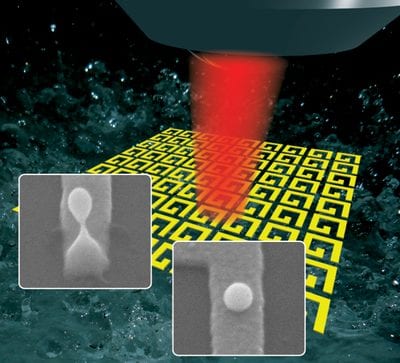

Using plasmonic hotspots, gold nanostructures can be melted and made to produce the smallest nanojets ever observed.

Researchers at the University of Michigan have developed a new system that uses dye-loaded nanoparticles to tag brain tumors for removal.

Anna Musyanovych of the Max Plank Institute for Polymer Research reviews Biodegradable Polymers in Clinical Use and Clinical Development.
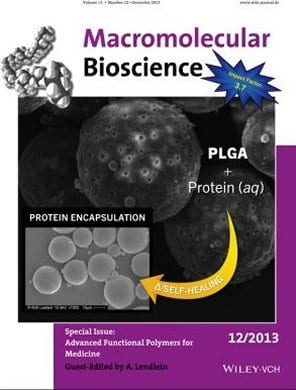
The complex requirements of modern medicine demand a variety of multifunctional materials. Polymers provide a versatile toolbox for such materials. Hydrolytically degradable polymers show temporal changes of mechanical properties during degradation and controlled drug...
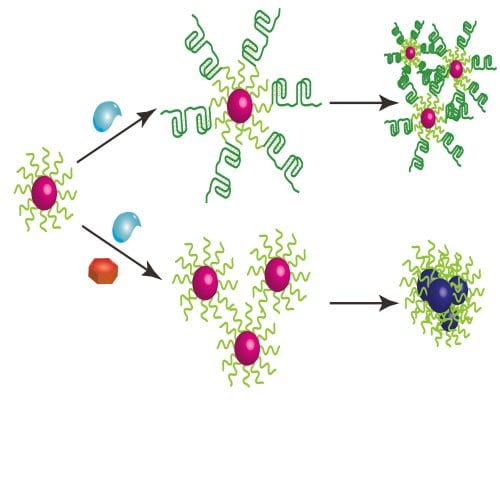
A new protocol combines gold nanoparticles with an enzyme substrate to give a simple test for the activity of an enzyme, the results of which can be seen with the naked eye.

Former Air Products and Chemicals senior researcher Francis Waller discusses intellectual property for today’s chemist.
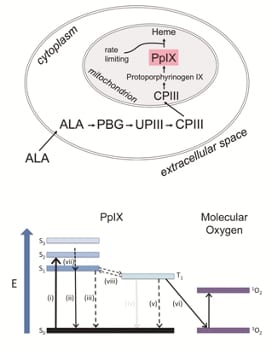
For measuring mitochondrial oxygen pressure clinically, just apply a cream on the skin.
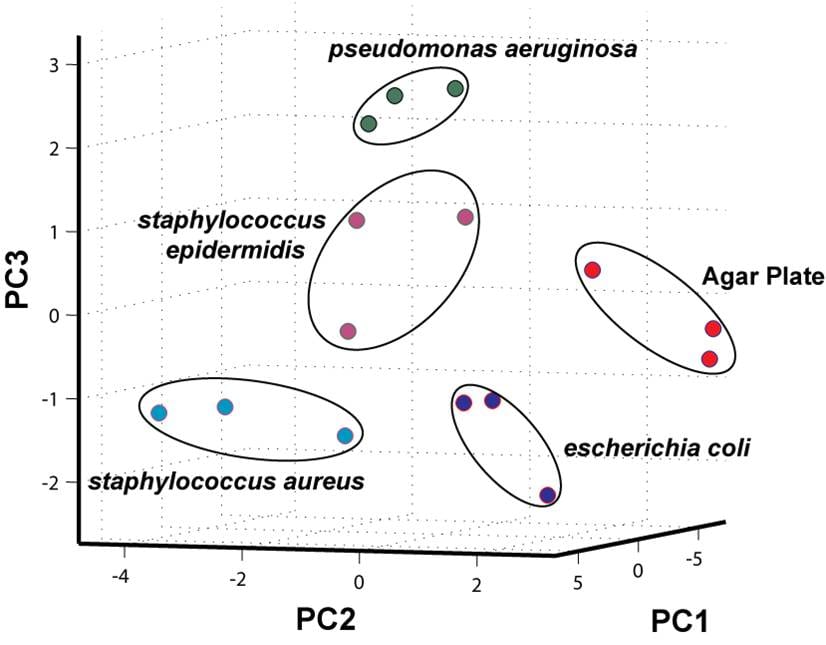
So what is next for nanochemical and biochemical sensor research? Shouldn’t we be trying to find the next glass pH electrode, rather than trying to squeeze that extra fraction of a percent out of our tried and tested materials?
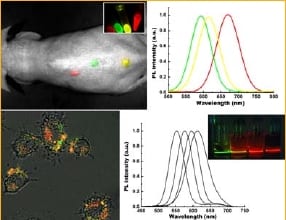
An international team of researchers review a useful tool for three dimensional multi-photon microscopy and imaging
A recent review gives an up-to-the-minute round-up of how mesoporous silica nanoparticles are used to deliver drugs into cells.
 New theory suggests gravity is not a fundamental force
 Higgs boson may be driving the Universe’s expansion
 Water-powered gadgets may be on the horizon thanks to new evaporation-based energy device
 Scientists discover a new class of antibiotics
 Micron-sized hidden dimensions could solve two of physics’ deepest puzzles
 A new type of dark matter could explain mysterious radiation from the Milky Way’s core