Researchers report the application of TRPT and fluorescence lifetime imaging microscopy (FLIM) for heparin sensing and bioimaging.
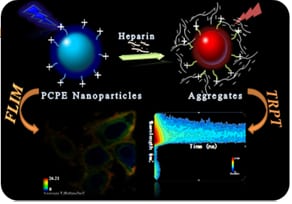

Researchers report the application of TRPT and fluorescence lifetime imaging microscopy (FLIM) for heparin sensing and bioimaging.
Researchers at King’s College London have achieved previously unseen levels of control over the travelling direction of electromagnetic waves in waveguides.
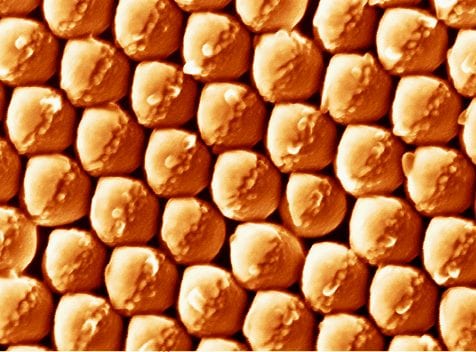
Novel hybrid system with gold nanocrescents evaporated over artificial opals shows unexpected optical properties.
Researchers have solved a long-standing materials science problem, making it possible to create new semiconductor devices using zinc oxide.

Pernice group at KIT use polycrystalline diamond for the fabrication of wafer-based optomechanical circuits.
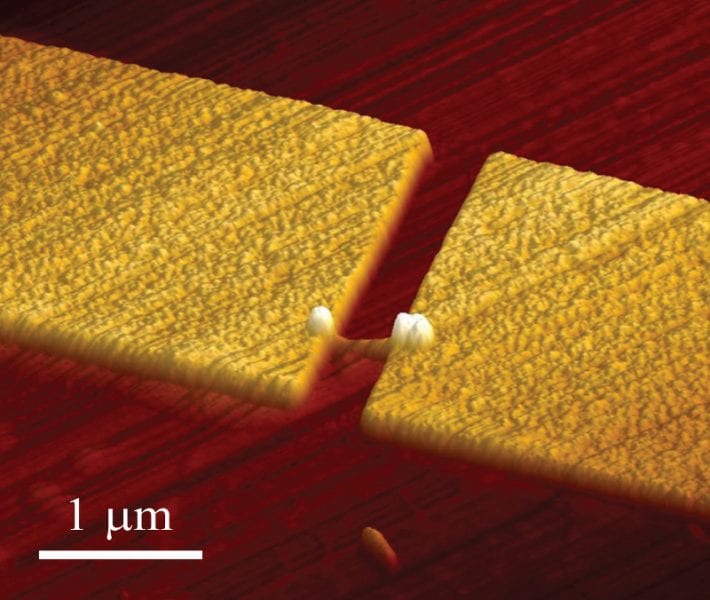
Researchers have demonstrated a simpler, more efficient single-photon emitter that can be made using traditional semiconductor processing techniques.
Researchers working to harness the quantum nature of light and semiconductors develop new logic system.

Research enables bulk silicon to emit broad-spectrum, visible light, opening the possibility of devices that have both electronic and photonic components.
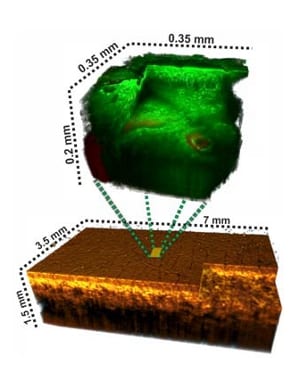
Combining two methods into a single platform opens up new possibilities for non-invasive 3D skin imaging.
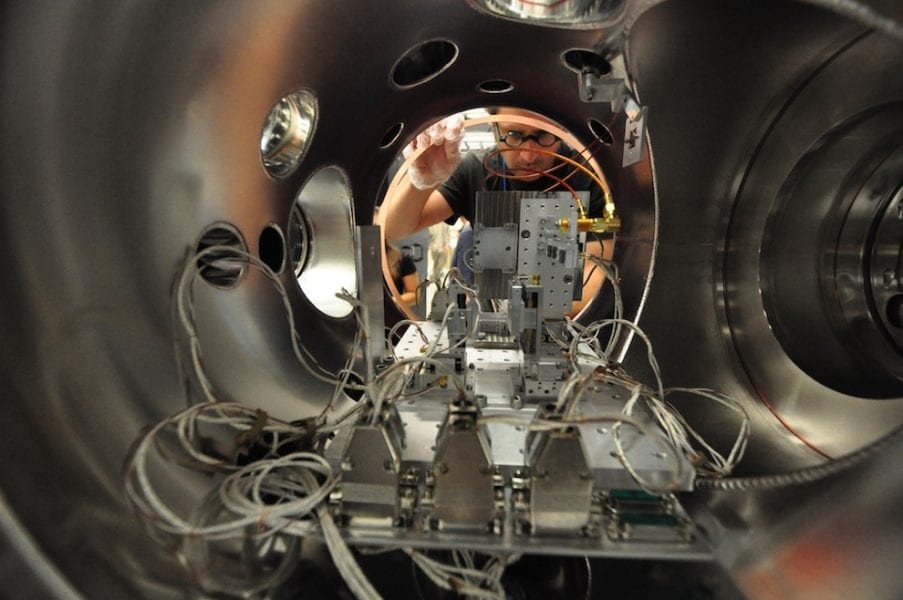
Using laser light to read and write magnetic data by quickly flipping tiny magnetic domains could help keep pace with the demand for faster computing devices.
 New theory suggests gravity is not a fundamental force
 Higgs boson may be driving the Universe’s expansion
 Water-powered gadgets may be on the horizon thanks to new evaporation-based energy device
 Scientists discover a new class of antibiotics
 Micron-sized hidden dimensions could solve two of physics’ deepest puzzles
 A new type of dark matter could explain mysterious radiation from the Milky Way’s core