
Ferroelectricity, Photoconductivity, and auxetic foams – these and more in May’s physics highlights.
Results for "graphene"

Low-Dimensional Carbon Materials
This special issue on low-dimensional carbon materials for Small is dedicated to the 20th anniversary of the Center for Nanochemistry at Peking University.

XG Sciences announce launch of new li-ion battery anode materials
Company claims that next-generation materials have four times the capacity of current anodes.
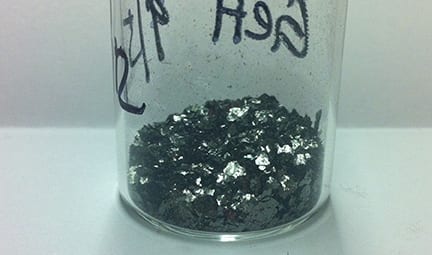
Single-atom germanium films could advance electronics research
Thin germanium films, with properties similar to graphene, could lead to lighter, faster electronics.
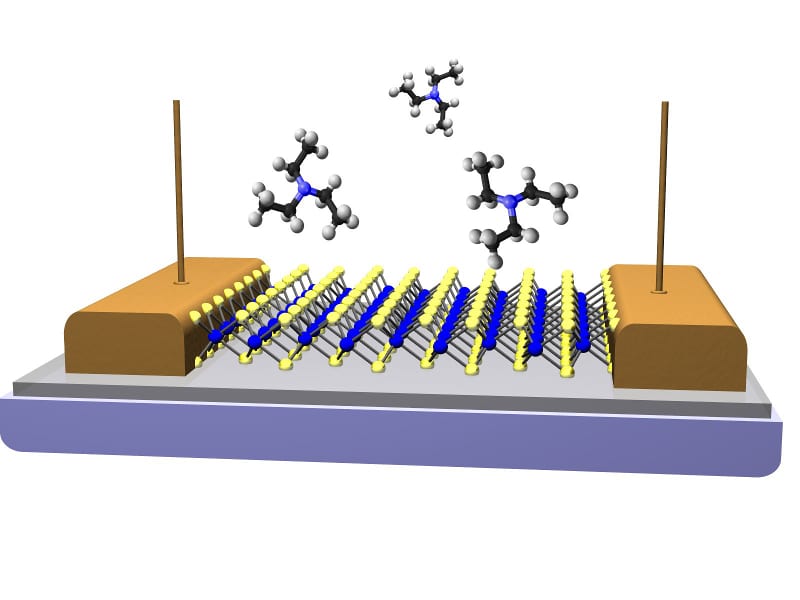
Monolayer molybdenum disulfide as a chemical sensor
NRL team develop a vapor sensor based on new monolayer materials that shows great potential for future nanoscale electronic devices.
A new way to make next-generation battery electrodes
Chinese researchers report a method to coat graphene with a transition metal oxide, with the aim to create new, better electrodes for Li-ion batteries.

Optical surface for new solar cells, computing, and sensing
New optical technologies using “metasurfaces” capable of the ultra-efficient control of light are nearing commercialization.
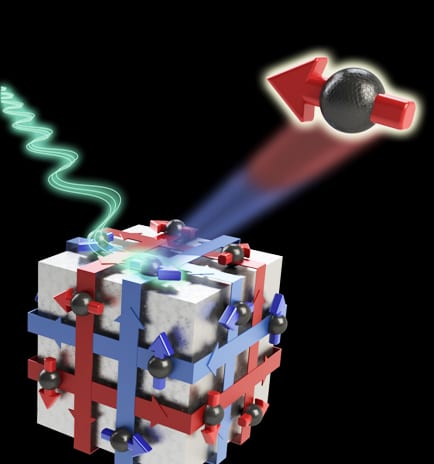
Unexpected photoelectric behavior from topological insulators
Team find that when TIs are hit with a laser beam, the spin polarization of the electrons they emit can be completely controlled in three dimensions.
Producing extra-fine carbon nanotubes easily and quickly
Carbon nanowires have been obtained by tempering diamantane dicarboxylic acid inside carbon nanotubes.
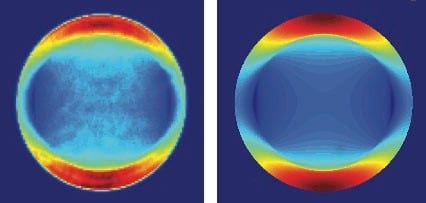
Nanomaterial light emission studies could improve optical imaging
Understanding the source and orientation of light in light-emitting thin films could lead to better devices that use layered nanomaterials.
Popular
-
 New theory suggests gravity is not a fundamental force
-
 Higgs boson may be driving the Universe’s expansion
-
 Water-powered gadgets may be on the horizon thanks to new evaporation-based energy device
-
 Scientists discover a new class of antibiotics
-
 Micron-sized hidden dimensions could solve two of physics’ deepest puzzles
-
 A new type of dark matter could explain mysterious radiation from the Milky Way’s core