Conductive metallic 3D nanostructures can be made inside a single crystal of a photocatalytically active metal-organic framework, say Belgian scientists.
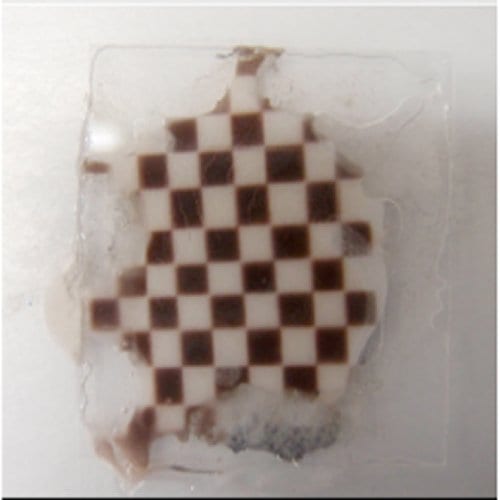

Conductive metallic 3D nanostructures can be made inside a single crystal of a photocatalytically active metal-organic framework, say Belgian scientists.
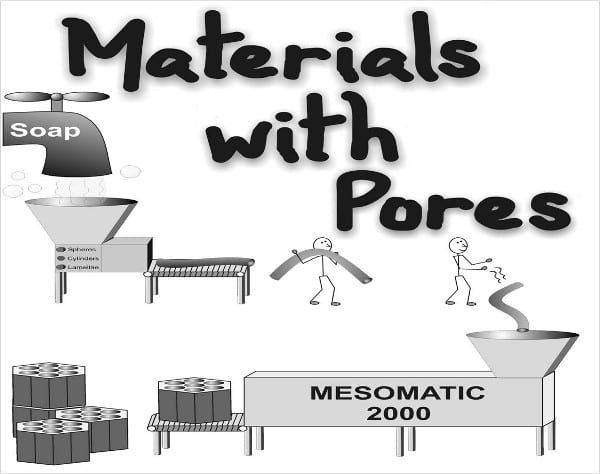
Professor Geoffrey Ozin from the University of Toronto reviews porous materials—how the research goals have varied over the years, where we are today, and what these materials may offer in the future.
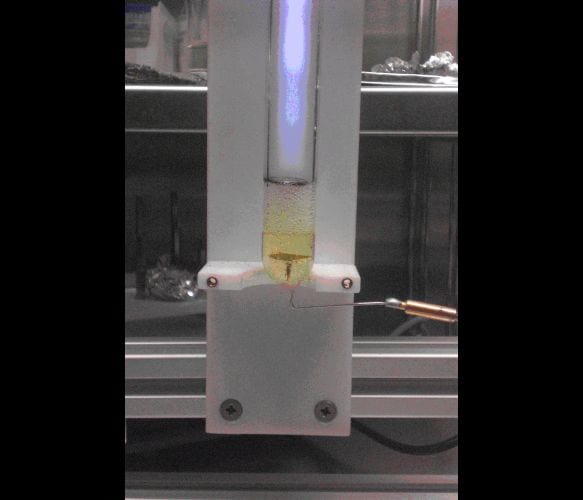
Copper nanoparticles can be made due to the interaction of an argon plasma with CuCl (CuCl2) ionic liquid solutions.
Welcome to one of our guest columns, where active researchers can share their views on topics relevant to materials science. Professor Geoffrey Ozin from the University of Toronto tells us what he thinks about nanoscale silicon and its future. One thing that has...
A recent review gives an up-to-the-minute round-up of how mesoporous silica nanoparticles are used to deliver drugs into cells.
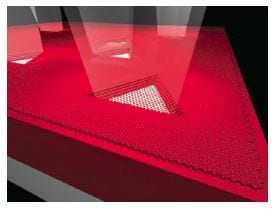
Graphene films grown over epitaxial metal films deposited on single-crystalline substrates give unique micropits with rectangular and triangular shapes, reflecting the crystallographic orientation of the substrate.
 New theory suggests gravity is not a fundamental force
 Higgs boson may be driving the Universe’s expansion
 Water-powered gadgets may be on the horizon thanks to new evaporation-based energy device
 Scientists discover a new class of antibiotics
 Micron-sized hidden dimensions could solve two of physics’ deepest puzzles
 A new type of dark matter could explain mysterious radiation from the Milky Way’s core