Novel application of 3D printing could enable the development of miniaturized medical implants, compact electronics, tiny robots, and more.
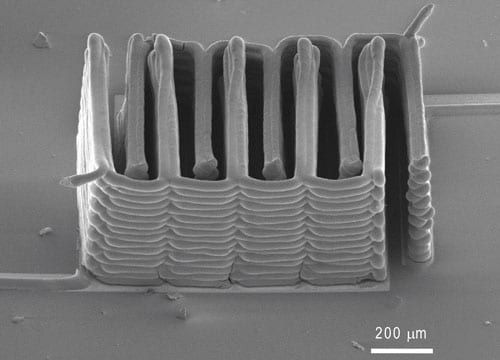

Novel application of 3D printing could enable the development of miniaturized medical implants, compact electronics, tiny robots, and more.
The Semiconductor Research Corporation and the National Institute of Standards and Technology have awarded UT Austin a $7.8 million nanoelectronics award.

Scientists at Aalto University and Utrecht University have created single atom contacts between gold and graphene nanoribbons.

Graphene can be made magnetic and its magnetism switched on and off very simply, opening a new avenue towards electronics with very low energy consumption.

Korean researchers develop a new process for rendering paper and textile fibers conductive with aluminum.

An international research team has shown the unique ways in which heat dissipates at the tiniest scales.

Researchers at the University of Washington have created a material to make LED bulbs cheaper and greener to manufacture, driving down the price.
Lanthanum aluminum oxide and strontium titanium oxide make conducting system when sandwiched together – Stanford researchers have investigated why.
Operational investment could total up to $1.69 billion over the next 15 years and potentially include facilities, manufacturing equipment and land.

Rice, Oak Ridge labs make semiconducting films for atom-thick circuits.

 New theory suggests gravity is not a fundamental force
 Water-powered gadgets may be on the horizon thanks to new evaporation-based energy device
 Micron-sized hidden dimensions could solve two of physics’ deepest puzzles
 Turning Periods into Power: Menstrual Blood a Valuable Resource for Medical Diagnostics
 Organic materials bring probabilistic computing closer to reality
 Kirigami-inspired neural probes are a cut above