Researchers shine light into muscle to detect instructions for artificial limbs.
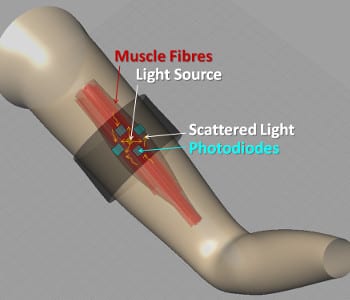

Researchers shine light into muscle to detect instructions for artificial limbs.
Researchers develop a high concentration graphene ink suitable for screen printing and a screen printing method for fabricating high-resolution patterns.
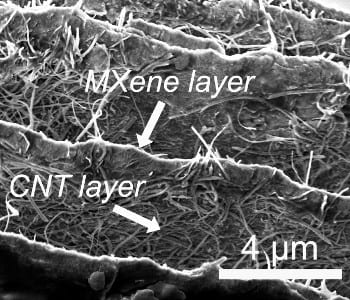
Flexible MXene/carbon composite electrodes composed of alternating layers of titanium carbide-based MXene and carbon nanotubes have been fabricated.
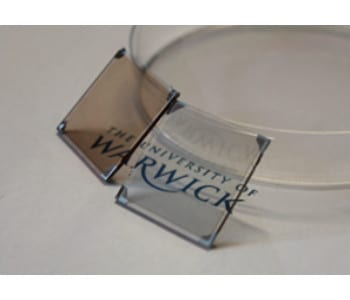
British researchers have reported a window electrode based on an ultra-thin bilayer of copper and amorphous tungsten sub-oxide.
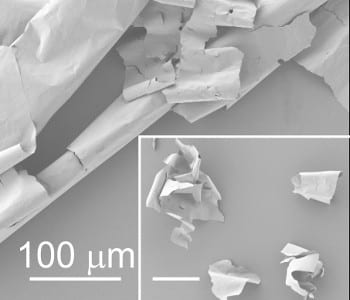
A German research team have fabricated magneto-electronics that fulfill the performance and processing requirements for consumer electronics.
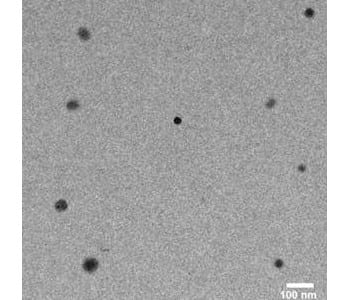
PDI-based organic nanomaterials have been successful developed and used for detection of deep human glioblastoma in mice models using photoacoustic imaging.
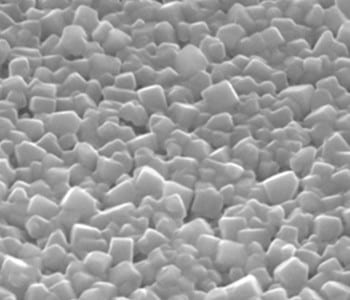
Researchers have formed perovskite films from a seed layer grown with atomic layer deposition, an standard technology for dielectric materials.
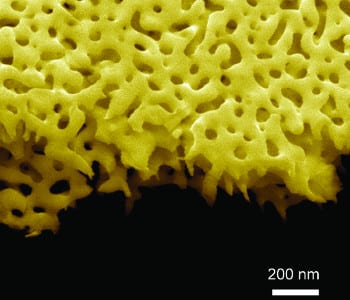
New research has found that “edge-free” monolayer MoS2 films supported by 3D nanoporous gold possess outstanding catalytic activity,
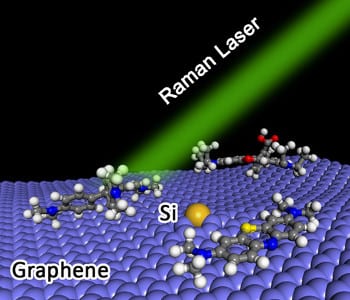
The Terrones group at The Pennsylvania State University in the US has reported a controlled technique able to dope graphene with silicon atoms.
Scientists from Nanyang Technological University (NTU Singapore) have developed a new battery that can be recharged up to 70 per cent in only 2 minutes.
 New theory suggests gravity is not a fundamental force
 Higgs boson may be driving the Universe’s expansion
 Water-powered gadgets may be on the horizon thanks to new evaporation-based energy device
 Scientists discover a new class of antibiotics
 Micron-sized hidden dimensions could solve two of physics’ deepest puzzles
 A new type of dark matter could explain mysterious radiation from the Milky Way’s core