
Researchers working to harness the quantum nature of light and semiconductors develop new logic system.
Results for "magnetic"

Carbon nanotubes could be the "bits" of quantum computers
Munich-based team show how nanotubes can store information in the form of vibrations.

New bulk silicon nanosystem for electro-photonic applications
Research enables bulk silicon to emit broad-spectrum, visible light, opening the possibility of devices that have both electronic and photonic components.
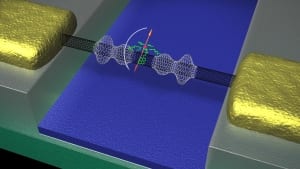
Quantum vibration sensor from carbon nanotubes
Researchers from the Karlsruhe Institute of Technology and French colleagues from Grenoble and Strasbourg build novel quantum mechanical system.

Writing data with an X-ray laser
Using laser light to read and write magnetic data by quickly flipping tiny magnetic domains could help keep pace with the demand for faster computing devices.
New microscopy technique to understand nanomagnets
NIST’s heterodyne magneto-optic microwave microscope can measure collective dynamics of electrons’ spins in individual magnets as small as 100 nanometers.

Optical surface for new solar cells, computing, and sensing
New optical technologies using “metasurfaces” capable of the ultra-efficient control of light are nearing commercialization.
Super-strong metallic composites from nanowires
Work effectively overcomes “valley of death” problem in nanocomposite design.
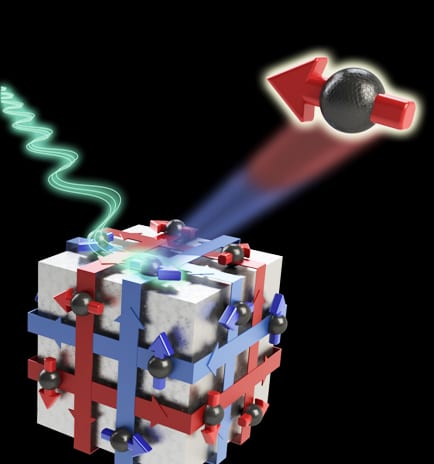
Unexpected photoelectric behavior from topological insulators
Team find that when TIs are hit with a laser beam, the spin polarization of the electrons they emit can be completely controlled in three dimensions.
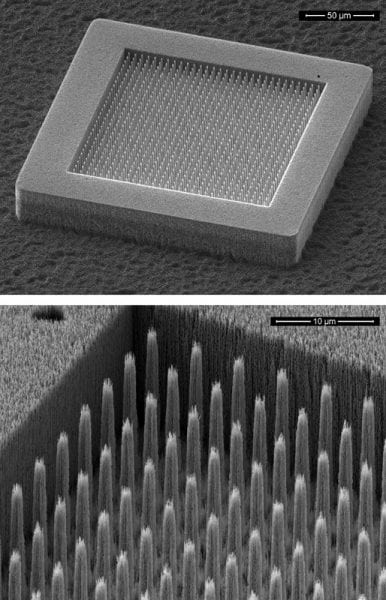
Nanostructured electron source developed at NIST
Researchers build a high-efficiency nanostructured electron source that could improve microwave communications and radar.
Popular
-
 New theory suggests gravity is not a fundamental force
-
 Higgs boson may be driving the Universe’s expansion
-
 Water-powered gadgets may be on the horizon thanks to new evaporation-based energy device
-
 Scientists discover a new class of antibiotics
-
 Micron-sized hidden dimensions could solve two of physics’ deepest puzzles
-
 A new type of dark matter could explain mysterious radiation from the Milky Way’s core