
What if your slice of cake could power its own temperature sensor, telling you exactly when it’s safe to eat?
A team of researchers has unveiled a breakthrough edible device that does just that, marking a major step toward safer food consumption and smarter food preparation. Indeed, we have already seen on multiple occasions how science fiction can often foresee solutions that eventually become real applications and incorporate many fundamental human wants in cutting-edge technologies. Until a few years ago, edible electronics could have been considered at an embryonic stage; scientific teams have since achieved tremendous progress in this field, designing and fabricating edible devices used as sensors and ingestible batteries, with a broad spectrum of applications from environmentally friendly alternatives to customised drug delivery and personalised healthcare.
Despite the significant advances, there are still many challenges to overcome to optimise the potential of this technology. The challenge behind this innovation begins with a simple limitation: very few edible materials are mechanically robust enough to be handled or integrated into devices. Common food gels—think of classic gelatin—collapse easily when moved, making them difficult to use for any functional purpose. Even tougher is the task of adding electronic‑like functionality, such as temperature monitoring, to materials that must remain entirely edible.
A team of researchers of École Polytechnique Fédérale de Lausanne, Switzerland, recently published a study in Advanced Functional Materials where they tackled these challenges, reporting the first ingestible electronic device specifically designed for food monitoring. In particular, they achieved robustness by strengthening chitosan, an edible biopolymer, through covalent crosslinking with vanillin, a flavour molecule found widely in confectionery.
This combination produces a hydrogel that is not only edible but also far sturdier than typical food gels. They were also able to introduce additional functionalities, such as the ability to monitor temperature evolution in such edible materials; monitoring of temperature evolution is necessary during transport and storage of frozen products, or during the preparation and consumption of food to obtain the desired result and prevent burns.
But the team went further: the capacity to monitor the temperature gradient does not rely on external batteries or other power supplies, but comes from the device design itself.
Traditionally, temperature‑harvesting electronics have relied on non‑edible materials. In this work, the authors chart new territory by designing the first fully edible thermoelectric system, a device that harvests heat from food itself—such as a freshly baked cake—to generate power. This self‑generated power drives another edible component: a colour-changing display that shows the evolving temperature of the food as it cools.
The thermoelectric generator is composed of hydrogels loaded with salts, and therefore charged. To convert temperature gradients into energy, a high ion mobility is needed; this is achieved by ensuring a high water content within the hydrogel and minimizing vanillin concentration. To maximize the voltage output, two different kinds of hydrogels, functionalized with chitosan or with alginate, are connected in series. Finally, to have displays showing the food temperature gradient, edible electrochromic materials (anthocyanins with food gelatin) that change colour upon voltage application are employed.
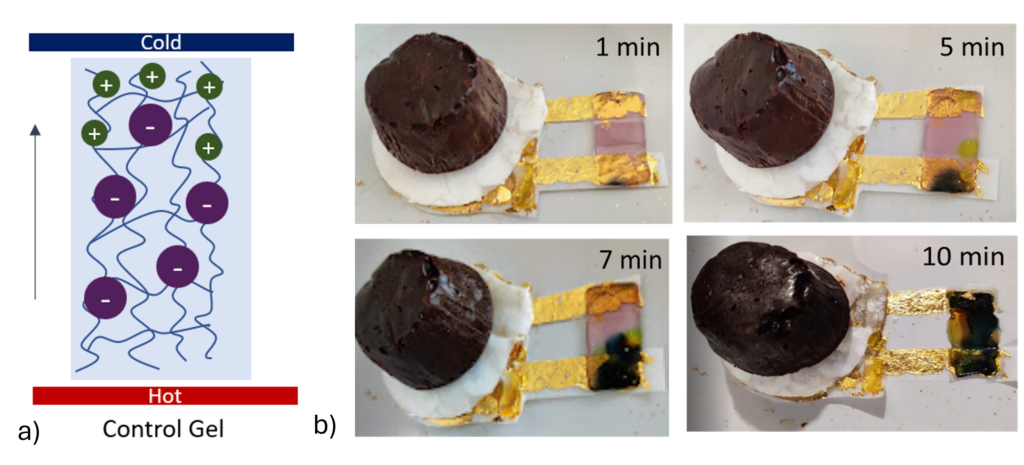
To demonstrate the concept, they embedded the device in a cake intended to be eaten while its centre remains molten. The edible display gradually turns blue once the temperature reaches a safe and optimal level – cool enough to avoid burns, but warm enough to maintain the dessert’s desired texture.
The key novelty, the authors explain, is straightforward but groundbreaking: every component in their system can be eaten.
This allows the device to be placed directly into or onto food, offering real‑time information that consumers can trust. Possible applications range from home kitchens to large‑scale food production and transport. Monitoring the temperature of frozen foods, judging cooking times, and preventing burns—particularly for infants and other vulnerable consumers—are all potential use cases. The main challenge ahead is to expand the temperature range over which these edible sensors operate. Future versions could be tailored to lower temperatures relevant to food storage and transport, enabling safer monitoring across the entire food supply chain.
Reference: Antonia Georgopoulou et al., From Food to Power: Hydrogel Thermoelectrics for Ingestible Electronics. Advanced Functional Materials (2026). DOI: 10.1002/adfm.202525982
Featured Image Credit: Valentina Bondarenko via Pexels