For decades, scientists have relied on surface-sensitive measurements to understand how cubic hexaboride materials like cerium hexaboride (CeB₆) behave at the electronic level. But a new study suggests that these observations may not always tell the full story: surface rearrangements can fundamentally change what experiments detect.
At first glance, CeB₆ has a simple cubic crystal structure yet, at low temperatures, competing quantum interactions give rise to unusual magnetic and electronic phases, making it a cornerstone material for understanding how electrons behave when they interact strongly with one another. For decades, it has therefore served as a model system in the study of strongly correlated electron physics.
To probe this rich physics, researchers often rely on surface-sensitive techniques such as scanning tunneling microscopy (STM) and angle-resolved photoemission spectroscopy (ARPES). These tools allow scientists to map electronic states with atomic precision; however, new discoveries by M. V. Ale Crivillero (Institut de Ciencies Fotoniques, The Barcelona Institute of Science and Technology, Barcelona, Spain), and colleagues suggest that such measurements may not always reflect the intrinsic behavior of the materials like CeB6.
Surface reconstructions hide an electronic gap
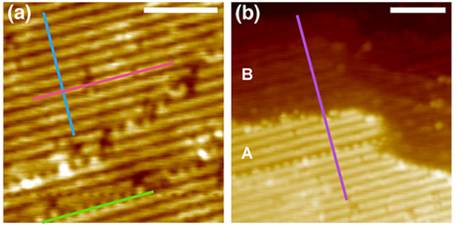
When a crystal is cleaved, bonds are broken; at the surface, atoms can rearrange to minimize energy, forming patterns different from those in the bulk structure. In CeB₆, this rearrangement appears to be the rule rather than the exception: in low-temperature, in-situ experiments, the team found that atomically flat, unreconstructed surfaces are extremely rare, typically extending only a few tens of nanometers. Instead, once the crystal is cleaved, most exposed regions quickly rearrange into new atomic patterns—known as surface reconstructions—before measurements are performed.
This finding has important implications. If STM or ARPES measurements are performed on reconstructed regions—knowingly or not—then the observed electronic spectra may reflect surface-specific effects rather than intrinsic bulk behavior.
On the rare unreconstructed areas, the researchers detected a partially opened energy gap of about 42 millielectronvolts at 4.6 K. Such a gap is widely considered as a hallmark of strong electron correlations and Kondo hybridization, where localized and itinerant electrons become entangled at low temperatures. But on reconstructed surfaces, the picture changes dramatically: the electronic spectra show modified low-energy features that differ substantially from those seen on clean patches.
To separate structural effects from intrinsic electronic physics, the team compared their measurements with density functional theory (DFT) calculations. While bulk calculations successfully reproduce the broad cerium and boron-derived bands observed in ARPES, they fail to account for the observed low-temperature gap. This mismatch reinforces a key point: many-body electronic interactions, which are not captured by standard DFT, are essential to CeB₆’s low-energy behavior.
Rethinking decades of surface-based measurements
The result resonates with earlier lessons from the closely related compound SmB₆, where surface reconstructions and valence changes dramatically alter surface electronic states. In f‑electron hexaborides, “the surface” is a dynamic, influential entity, not a static window into the bulk: it may actively reshape what we see.
The consequences are far‑reaching. Surface condition must be treated as a primary variable in any surface‑sensitive study of CeB₆: without verifying surface quality, conclusions about gaps, coherence features, or emergent surface states risk being misattributed.
The finding helps explain discrepancies in older STM and ARPES studies: different surface terminations likely led to different spectra.
CeB₆’s surface sensitivity also holds technological relevance. The compound is widely used as a thermionic and field‑emission cathode because of its low work function and stable emission — properties that depend directly on surface termination. This means controlling reconstruction isn’t just an academic challenge, but also an engineering one.
Looking forward, the authors emphasize the need for ultra-low-temperature STM (down to about 1 K) and measurements under applied magnetic fields to track how the gap evolves across different magnetic phases. On the theoretical side, more advanced computational approaches that explicitly account for strong electron correlations will be required to capture the full many-body physics at play.
As researchers push toward ever lower temperatures and higher resolutions, CeB₆ reminds us that sometimes the most familiar materials still have new stories to tell — especially at their boundaries. As senior co-author Steffen Wirth puts it, “CeB₆ is one of the structurally simplest Kondo lattice systems but still challenges our understanding of strongly correlated electron systems.”
If the surface of such a well-studied ‘classic’ material can still reshape our interpretation of its physics, what other quantum systems might be hiding similar surprises?
Reference: M. Victoria Ale Crivillero et al., Surface Properties of CeB6 and Challenges in Surface Preparation Revealed by Scanning Tunneling Microscopy. Advanced Physics Research (2026). DOI: 10.1002/apxr.202500220
Featured image credit: Gerd Altmann via Pixabay