Scientists from Berkeley and TU Munich investigate magnons in a material that becomes helimagnetic below about 30 kelvin: iron silicide doped with cobalt.


Scientists from Berkeley and TU Munich investigate magnons in a material that becomes helimagnetic below about 30 kelvin: iron silicide doped with cobalt.
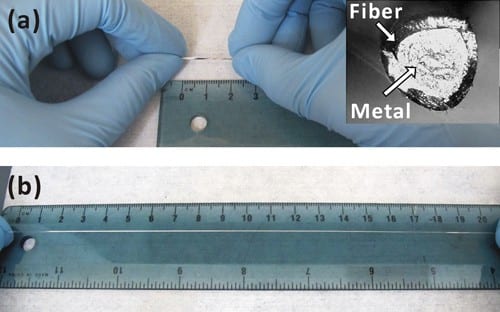
Researchers from North Carolina State University have created conductive wires that can be stretched up to eight times their original length while still functioning.
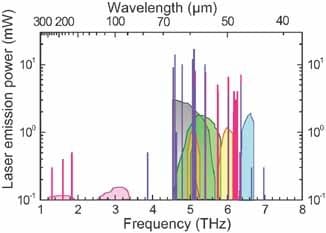
Stimulated emission between impurity levels in silicon is a promising source of terahertz laser radiation.

A research team from KAUST in Saudia Arabia have fabricated all-polymer nonvolatile bistable memory devices with potential for use in flexible and transparent electronics.
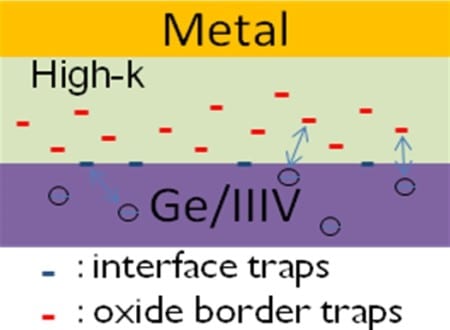
At the recent IEEE International Electron Devices Meeting (IEDM 2012), imec addressed key challenges of scaling beyond silicon-channel finFETs.
IBM announced today a major advance in the ability to use light instead of electrical signals to transmit information for future computing.
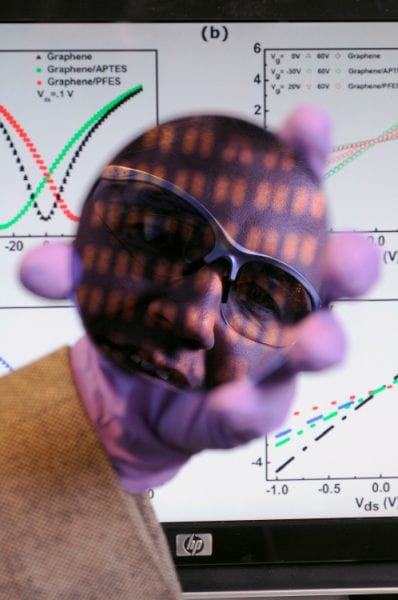
Researchers create junctions, essential to electronics fabrication, by transferring graphene films onto patterned monolayer substrates.
Electronics coating firm expands business in Turkey, Qatar, the United Arab Emirates and Saudi Arabia.

Engineers create a device that can focus light into a point of just a few nanometers, with applications in computing, communications, and imaging.
A state-of-the-art welding process refined for use in naval shipbuilding by the Office of Naval Research (ONR) has crossed over to the world of computing.
 New theory suggests gravity is not a fundamental force
 Higgs boson may be driving the Universe’s expansion
 Water-powered gadgets may be on the horizon thanks to new evaporation-based energy device
 Scientists discover a new class of antibiotics
 Micron-sized hidden dimensions could solve two of physics’ deepest puzzles
 A new type of dark matter could explain mysterious radiation from the Milky Way’s core