Copper nanoparticles can be made due to the interaction of an argon plasma with CuCl (CuCl2) ionic liquid solutions.
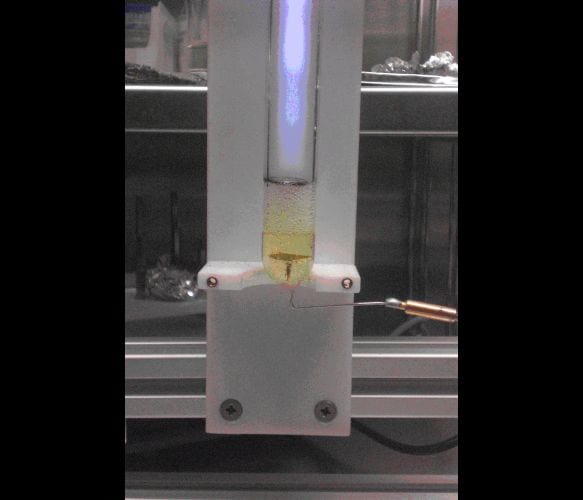

Copper nanoparticles can be made due to the interaction of an argon plasma with CuCl (CuCl2) ionic liquid solutions.
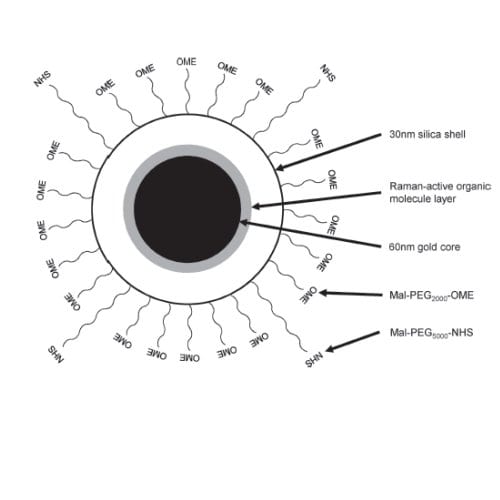
US scientists show the mechanism of toxicity of gold nanoparticles in living cells, and demonstrate that the nanoparticles are not toxic under diagnostic conditions.
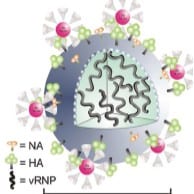
Functionalized gold nanoparticles are used to prevent flu viruses from attaching to and entering cells, in research by German scientists.
Progress towards multifunctional biomedical applications for silica-based nanoparticles is described by Prof. Taeghwan Hyeon
A recent review gives an up-to-the-minute round-up of how mesoporous silica nanoparticles are used to deliver drugs into cells.
Ever wondered if your food has been kept cold enough before you buy it? Here’s a way to find out…using nanoparticles to sense and record temperature changes.
Gallium arsenide is infiltrated for the first time within porous nanoparticle-based periodic multilayers to yield a new structure displaying finely tuned enhanced optical reflectance.
Scientists who are interested in the latest progress in non-spherical noble metal nanoparticles will probably appreciate the new review articles by Tapan K. Sau and Andrey L. Rogach.

A hybrid electrolysis system produces hydrogen while upgrading glycerol into valuable chemicals.

Young Innovator Awardee for 2025, Komor leads a group at UCSD developing precision genome editing methods using chemical biology.

 Micron-sized hidden dimensions could solve two of physics’ deepest puzzles
 Turning Periods into Power: Menstrual Blood a Valuable Resource for Medical Diagnostics
 Bone loss in obesity traced to gut microbiota
 Surfactants Steer Supraparticle Structure
 Edible electronics realize safe, complex monitoring devices
 Fermilab Confirms Muon g-2 Measurements