Professor Ozin pays tribute to the materials scientists and engineers working to counteract the effects of fossil fuel induced climate change.
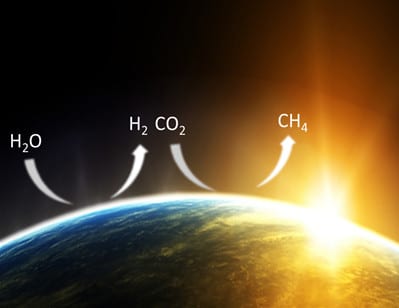

Professor Ozin pays tribute to the materials scientists and engineers working to counteract the effects of fossil fuel induced climate change.
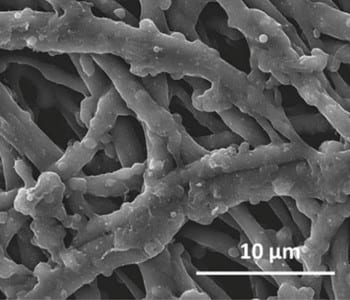
Professor Manthiram’s group at the University of Texas at Austin develops a naturally derived carbonaceous material for use in dye-sensitized solar cells.

The Norwegian company Sintef is testing materialsfor the production of oil and gas at Arctic temperatures between -40 and -60°.
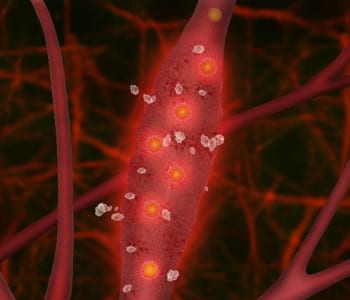
Researchers highlight the potential and current biological and biomedical applications of micro- and nanoparticle research.
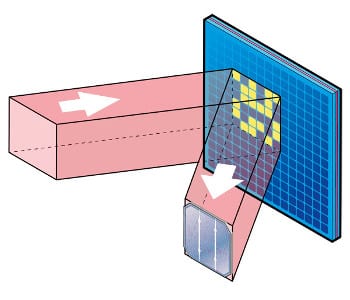
Scientists NPL have developed a new method for detecting defects in solar cells using a technique called ‘compressed sensing’.

ChemNanoMat is the latest journal to be launched by Wiley-VCH and opened for submissions at the beginning of November.
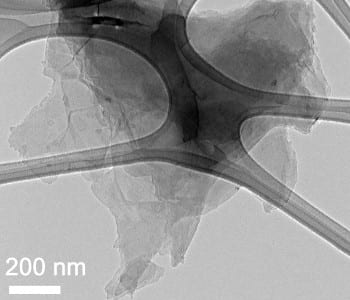
A team introduce a soft processing approach for the continuous synthesis of high-quality graphene nanosheets via electrochemical exfoliation of graphite.
Researchers develop a high concentration graphene ink suitable for screen printing and a screen printing method for fabricating high-resolution patterns.
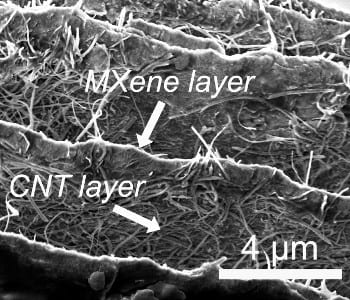
Flexible MXene/carbon composite electrodes composed of alternating layers of titanium carbide-based MXene and carbon nanotubes have been fabricated.
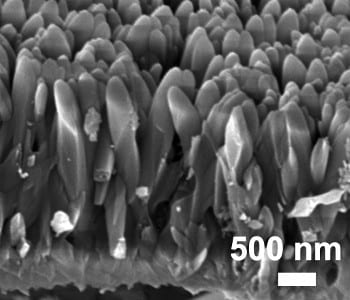
Densely aligned SrTiO3-modified rutile TiO2 heterojunction photocatalysts have been crafted by a Chinese/American collaboration.
 New theory suggests gravity is not a fundamental force
 Higgs boson may be driving the Universe’s expansion
 Water-powered gadgets may be on the horizon thanks to new evaporation-based energy device
 Scientists discover a new class of antibiotics
 Micron-sized hidden dimensions could solve two of physics’ deepest puzzles
 A new type of dark matter could explain mysterious radiation from the Milky Way’s core