Wildfires can dramatically reshape animal habitats in a matter of days, stripping away shade and exposing surviving species to extreme heat. New research shows that a common Mediterranean lizard responds to intense fires by lightening its coloration, likely to curtail heat stress.
“Our findings suggest that some species have the ability to adjust rapidly to postfire conditions, but this flexibility has limits,” Lola Álvarez-Ruiz, a researcher at the Centro de Investigaciones Sobre Desertificación in Spain and author on the paper, wrote in an email to Advanced Science News.
Certain animals, such as lizards, are heavily reliant on external sources of heat for most physiological functions. When temperatures fall outside a critical range of tolerance, stress can gravely affect operations. With vegetation often guiding temperatures, fire-driven changes in plant cover can inspire behavioral and other changes in affected critters. Oftentimes, despite the loss in shade and rise in searing heat, animals stick around in their burned habitats. Álvarez-Ruiz and colleagues wondered if lizards living in the Iberian peninsula, an area prone to intense wildfires, would alter their physical traits to endure their changed circumstances.
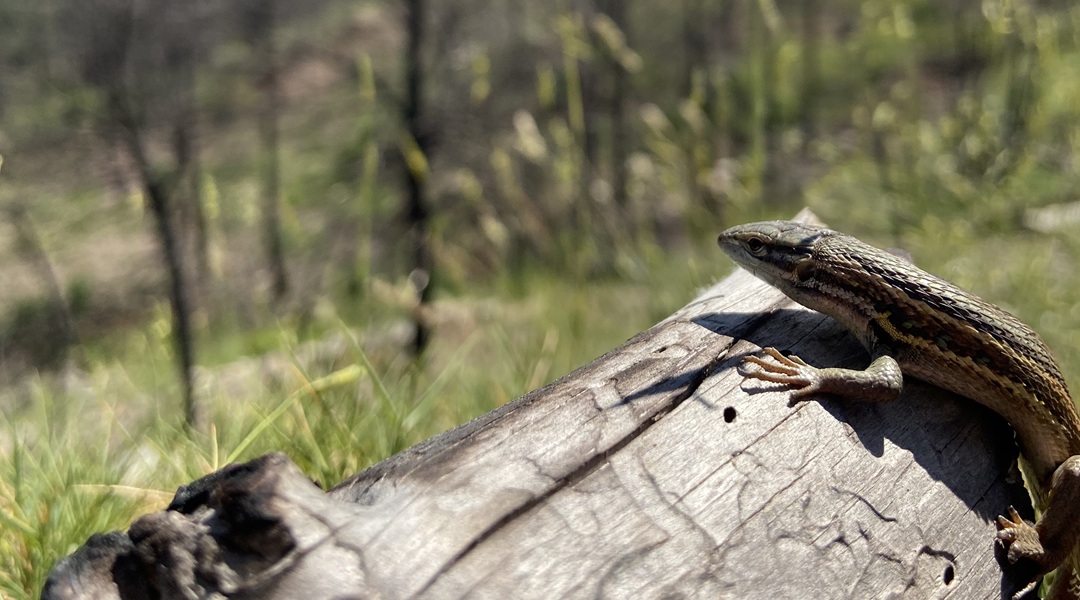
The Psammodromus algirus, a common Mediterranean lizard, has a limited range, continuing to persist in scorched areas. The researchers assumed that these lizards would grow lighter after a wildfire to ameliorate the risk of overheating with little vegetation remaining.
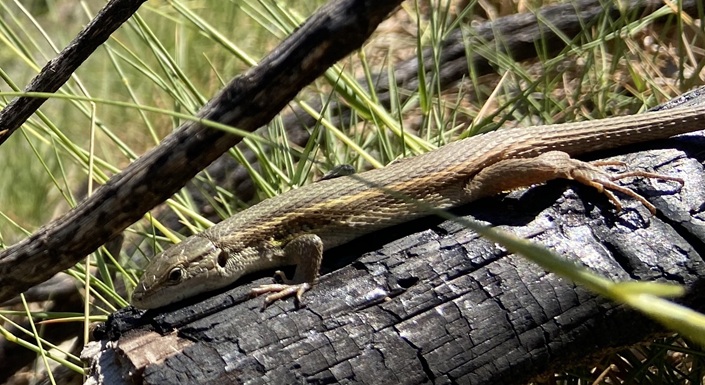
They focused on five areas that suffered wildfires from 2018 through 2020, spanning landscapes burned as recently as three months prior and as long ago as two years. They photographed more than 190 lizards, some taken from burned areas and others from nearby unburned areas. “Because we sampled sites with different times since fire (from a few months to two years), we could see how coloration changed as the habitat recovered,” said Álvarez-Ruiz.
The team found that lizards dwelling in recently-burned areas become lighter but, as the vegetation came back, so did the lizards’ darker coloration. Lizards in unburned areas were dark, olive brown, while those in burned areas were gray-yellow. As lighter colors reflect more sunlight, brighter-toned lizards can better adjust to heat in burned, exposed landscapes.
The researchers also noted that size was a crucial variable in color changes in these lizards: larger lizards living in burned areas were more likely to undergo a color change. “Smaller lizards have a higher surface-to-volume ratio, which means they heat up and cool down faster and can rely more on behavior, such as quickly moving between sun and shade,” added Álvarez-Ruiz. “Larger, adult lizards have a lower surface-to-volume ratio and retain heat for longer, so overheating may be a bigger risk for them.”
These lizards favor living amongst low shrubs, which probably grow back within two years, accounting for the reversion of color. According to Álvarez-Ruiz, measurements of body temperature changes in the lizards are still needed to validate the connection between color changes and heat absorption. The team also wants to determine what costs the lizard must incur, whether to its metabolism, growth or reproduction, to make the color change.
“Fire itself is not a disaster, it’s a natural element in many ecosystems and plants and animals have evolved with it under certain frequencies and intensities,” added Álvarez-Ruiz. “What makes fires dangerous today is the rapid change in fire regimes driven by climate change and human activity. Understanding how animals respond to fire helps us identify both their resilience and their limits in this new context.”
Reference: L. Álvarez-Ruiz et al., Rapid postfire color shift in a Mediterranean lizard, Journal of Zoology (2025). DOI: https://doi.org/10.1111/jzo.70083
Feature image credit: L. Álvarez-Ruiz et al.