
In this interview, Elisenda Lara, EPIC’s MarCom Manager, talks with Laura Horan, Staff Engineer and Head of Product Management at Vanguard Automation, about how young people can be inspired to join the photonics industry.
How has your career in photonics evolved?
Physics has always been my calling. As a child, I was very curious about how the world worked and how everything interconnected. This passion drove me to pursue a physics degree and, subsequently, a PhD in the Photonics Systems Group at the Tyndall National Institute in Ireland, where I explored the potential of hollow core photonic crystal fibres for biomedical sensors.
What did you learn from your PhD?
As a PhD student, I learned to rely on my own motivation and ability to tackle incredibly complex topics, and to break down challenges into manageable steps. I developed skills in project management, the critical evaluation of scientific literature, and incorporating theoretical concepts into practical applications. Plus, I gained invaluable practical skills in engineering, optics, electronics, and programming.
What did you do after your PhD?
I knew it was time to make the move from academia into industry. My career path led me to Southampton in the UK to design contact lenses and metrology equipment for qualifying products in R&D and manufacturing. A contact lens actually is quite a complex optical part – you wouldn’t believe it, but there’s a lot of design going into these lenses!
I then transitioned to Germany, where I designed optical sensors for the automotive market, managed high profile projects for key market players and led interdisciplinary teams of engineers. My job was to bring new concepts and optics from the design phase right up to production, going to different manufacturers to discuss details of how to manufacture the optical parts and going to customers to explain these technical ideas and get them accepted.
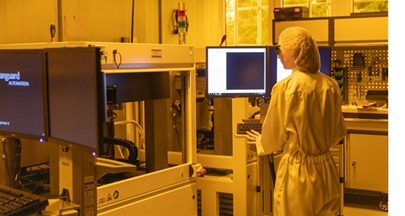
In 2022, I joined Vanguard Automation, first as a Senior Applications Engineer responsible for the product development of photonic wire bonds (optical waveguides connecting the optics across different hardware components). My significant contributions and strong industry experience led to my promotion to Staff Engineer, and I now head up product management for our 3D nano-printing technology, to advance photonic integration in the photonic integrated circuits and photonics markets.
What have been the main challenges in your career development?
My initial challenge was the shift in perspective between academia and industry. In research, the focus is on proving the first novel concept; however, industry demands a focus on a minimum viable product – that is, a product that can be produced reliably and repeatably and which meets customer requirements. This is incredibly challenging, particularly for complex products with a wide range of manufacturing steps. For example, when I worked on automotive sensor development, it was critical to ensure that the electronics, software and optics worked seamlessly together for all design revisions and could be manufactured within our process tolerances.
Another challenge was learning how to adapt myself and my talents in different countries and industries. In Germany, CVs are required to have a profile picture and include personal details such as marriage status and family information; this is not required for job applications in the UK or in Ireland.
But, for me, the biggest challenge throughout my career has been the scarcity of female role models in leadership positions. Engineering disciplines are still very male-dominated fields and, while trying to fit in with your colleagues, it is easy to lose your sense of self and your inherent strengths as a woman.
Typically, men and women have a very different set of soft skills and ways of communicating; when you’re working in a male-dominated field, the methods of communication, leadership styles and soft skills that you are exposed to do not always translate effectively for women. I’ve had to develop my own set of soft skills through trial and error, a process that has been time-consuming due to the lack of female guidance.
What were the main differences between automotive and photonics?
In general, the automotive industry is very conservative, procedure-driven and formal. When you apply for a job, the colours you chose to wear in your CV photo and for in-person meetings need to be muted. In interviews, the focus is on what benefits you have brought to your previous company, for example, the number of systems sold and the percentage increase in efficiency. There is less focus on getting to know your own character and individuality, and there are strong hierarchies to consider and to learn to work within.
In contrast, the photonics industry is young, fresh and far more informal. Photonics companies value creativity so, at an interview, you should present yourself as innovative, capable of driving things forward, and very adaptable to market changes. The focus is on understanding your personality, determining that you are capable and willing to work in a very dynamic environment and can bring new ideas.
How important is it to have a gender balance in engineering roles?
When I joined industry, I was usually the only woman in the engineering teams. I think it’s incredibly important that women have a voice in engineering because engineers create the entire world around us – what we see, what we touch, and everything we interact with. And if women don’t have a say in these important design decisions, the world won’t be designed to meet our needs.
There are so many examples today in how the world has been designed with an unconscious bias. When I worked in the automotive industry, we needed to wear steel toe-capped safety shoes. They were meant to be unisex but were essentially not designed for female feet. As a result, I was always falling and tripping – not very safe! In the same way, many mobile phones are too big for women’s hands, overhead luggage compartments in planes and trains are too high for most women to reach comfortably, and there is frequently not enough space in public transport for children’s prams. These are simple aspects of our lives which could be improved if women had more voices at the engineering design stage.
How do you see the future of engineering in photonics?
Right now in photonics, we’re moving towards standardising design and engineering, creating automated machinery, and building production lines capable of mass production. Similarly, we’re going to start seeing the standardisation of fabrication routines for manufacturing photonic components and products. To achieve this, companies must prioritise skill development, providing training, solid on-boarding programs, and encouraging the development of a wide range of necessary skillsets, and this takes time. Photonics engineering is an on-the-job learned skill, and we must cultivate training programs to bring people to the right level and to encourage them to move forward as engineers in their careers.
Taking Vanguard Automation as an example, what type of background fit best with photonics?
We are a diverse team of skillsets and nationalities. We have PhDs who work on the most technically challenging concepts, people from traditional engineering backgrounds, and testing specialists to ensure our products are reproducible and reliable. Knowledge of machine building and automation is essential. Our most important people have excellent hand coordination and patience and can fabricate very small assemblies using microscopes and tweezers.
What’s your advice for a young person thinking of a career in photonics?
If you are a young person and you have ambitions to solve our most pressing challenges and drive technology forward, or you want to be part of an industry revolution that is really going to change our world, this is the career path for you. Photonics is young and dynamic with many opportunities. Unlike traditional industries, there are no established models or methods, so you can be yourself, you can be creative and bring new ideas. The photonics industry is waiting for young people out there to become involved and create a new industrial future. The best thing about a career in photonics is that anything is possible.
Image credits: Laura Horan/Vanguard Automation