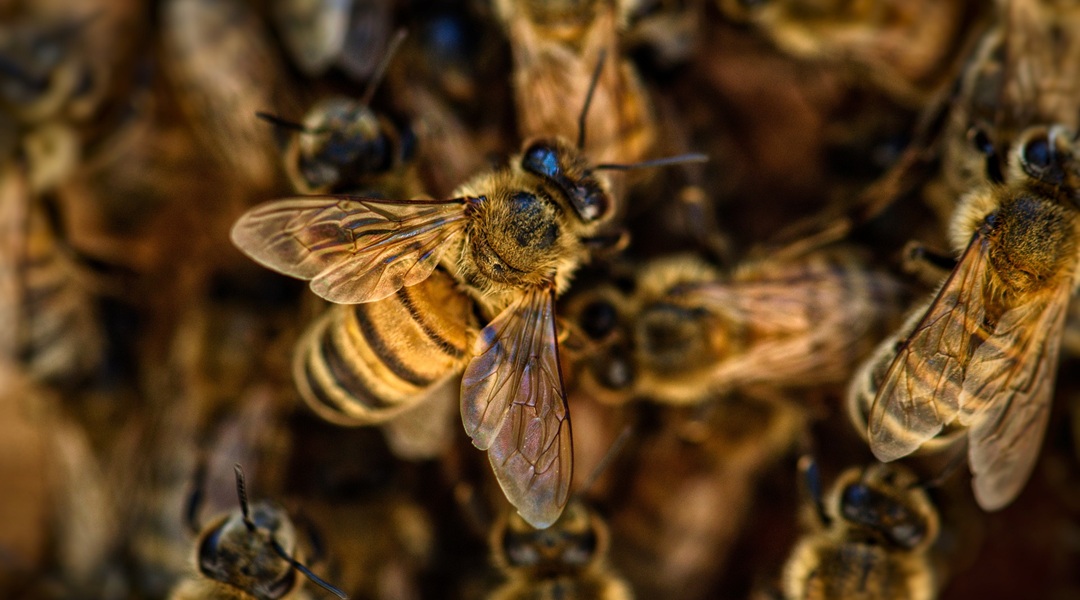
For social insects, the colony’s frailest members may offer the best defense against specific stressors. In an experiment that validates the newly proposed Weak Worker Hypothesis, researchers report that heat-prone honey bees rush to fan the hive, driving division of labour across the colony.
Social insects like ants and bees are known to rely on various cooperative behaviours, with members performing specialized duties that benefit the colony as a whole, allowing for the collecting of resources and building of nests. The ‘response threshold’ model is the most prevalent one used to explain how members in insect colonies are organized for labour. According to this model, members of the colony have differing thresholds to stimuli. Depending on the stimulus level, some members respond by performing particular tasks which, in turn, lowers the stimulus at a colony level.
The evolutionary and biological underpinnings of this model have, however, not been well established. Jacob Herman, a researcher at the University of Alberta, in Canada, and colleagues put forward what they call the Weak Worker Hypothesis: Division of labour occurs because individuals most vulnerable to a stressor act as first responders.
Heat tolerance in honey bee colonies
In order to test this model, the researchers conducted a heat tolerance experiment using honey bees. When subjected to heat at the colony level, some bees stationed at hive entrances flutter their wings, acting as fanners. To begin with, the team exposed experimental hives to hot air, known to trigger fanning behavior in bees with the intention of regulating temperature. Then, they separated these fanner bees from the rest of their hive mates. They also collected non-fanner bees to form a control group.
To test the bees’ ability to withstand high temperature when separated from the hive, the researchers exposed individual bees from the fanner and non-fanner groups to lethal heat. Bees that began fanning earlier died earlier than the non-fanner bees, suggesting they were much more susceptible to heat.
The researchers advise that this model may not justify all forms of behavioral responses in social insects. For instance, insects that protect hives may have different physical structures to assist in such behaviors, while insects that help keep hives clean from disease-ridden members may be more, rather than less, tolerant to microbes. “If true, this would have implications for honey bee health research, suggesting the importance of maintaining a diversity of individual susceptibility to pathogens in colonies to ensure effective hygienic behaviour to reduce disease at the colony level,” wrote the researchers.
Weak Worker Hypothesis
While this study is the first to put forth and experimentally test the Weak Worker Hypothesis, research on cold tolerance in honey bees has previously shown that the bees which first begin generating heat in winter are also more likely to suffer from cold exposure when outside the hive.
“We suggest that the Weak Worker Hypothesis should be tested for each specific task, and could not only improve our understanding of division of labour in social insects but also clarify the origins of response thresholds,” add the researchers. Knowing that individual-level cold tolerance can influence colony-level heat generation is important for beekeeping, especially through winters when overwintering bees vibrate their wings for warmth.
Historically, beekeeping practices have chiefly relied on choosing specific traits at the colony level. But choosing for individual traits may offer more payoff in the future, especially when considering the current plight of honey bees. “The Weak Worker Hypothesis argues that selection for variation in stress susceptibility might be more successful than unidirectional selection for higher stress resistance,” conclude the researchers. “A fraction of susceptible workers could be important to regulate and perform colony-level defences.”
Reference: J. J. Herman et al., The Weak WorBees susceptible to heat are first to step up and help the hive cool down through fanning behaviours.ker Hypothesis: A New Framework for Understanding Division of Labour in Social Insects, Biological Reviews (2025). DOI: https://doi.org/10.1111/brv.70068
Feature image credit: Terri Sharp via Pixabay