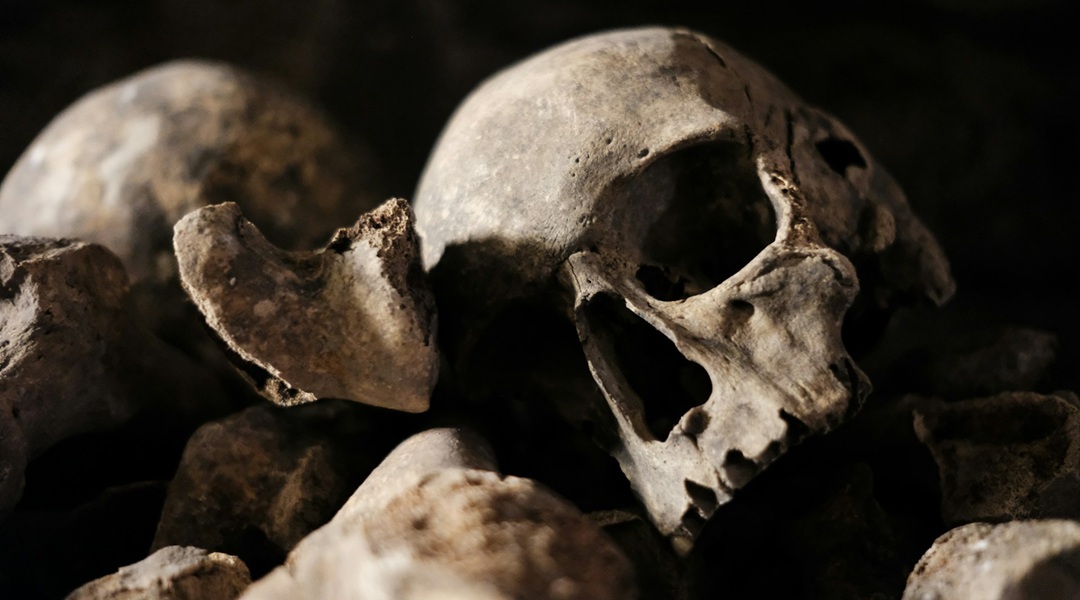
The fossilized skulls of our ancient ancestors hold faint impressions of the brains that once pressed against them, but reading those marks has been quite subjective. Now, researchers have established a framework, based on comparative imaging data of 75 living people, to decrypt these markings.
The brain’s surface consists of furrows, called sulci, and ridges, termed gyri, that help increase the brain’s surface area. As the brain presses up against the skull, these structures form marks on the inside of it. For decades, researchers have used these marks in the skulls of our ancestors to better understand the functioning and form of the evolving brain; as the soft tissues of brains do not fossilize, the enduring endocast, marked on the inside of skulls, is essential to this understanding.
Antoine Balzeau, a researcher at the Musée National d’Histoire Naturelle, Paris, and colleagues used high-resolution MRI technology to directly compare the brain and its resultant endocast in living individuals for the first time ever. The team recruited 75 individuals, as part of the PaleoBRAIN project, who underwent MRI at the Pitié-Salpêtrière Hospital, in Paris. While most imaging of fossils nowadays relies on microtomography (micro-CT), the researchers used a specific MRI approach for their study to avoid exposing their participants to radiation.
Over two years, the team used this data to reconstruct 3D models of the brain, its lining and the endocast.
“For 75 individuals, we analyzed all visible marks and were able to identify what they actually correspond to on the underlying brain,” writes Balzeau in an email to Advanced Science News. “There is no longer any subjectivity: we demonstrate this in every direction and provide access to all 3D models, including numerous endocasts that are perfectly described. This is why we titled this work ‘the Rosetta Stone of paleoneurology’.”
In fossil studies, endocasts are often interpreted on the basis of brain atlases, which reference uniform, elongated sulcal marks. But each sulcus can branch out in unique ways and, with so much diversity in sulcal patterns across individuals of the same species, endocasts naturally also manifest these variations. “And since not all sulci leave marks along their entire length on the inner surface of the skull, the result is a series of short, discontinuous marks, more prevalent toward the lower regions of the brain where contact with the skull is strongest,” adds Balzeau.
Their findings are contrary to the old ways of analyzing marks on endocasts as long and straight. A more objective understanding of the wide range of features observed in humans could help tease out the differences in brain form and, possibly, function in our ancestors.
In addition to these differences in the types of marks found, the researchers also came across markings that did not match up with sulci in the brain, which they termed Marks Not Associated with Sulci (MNAS). About 12% of the markings on the endocast, particularly those near its top, fall into this category. While they look akin to markings corresponding to sulci, there were no sulci at the equivalent spots on the brain, suggesting other contributing features may be at play.
These as-yet unexplained markings can be problematic when analyzing fossil endocasts, with researchers cautioning that interpretations should prioritize well-established markings. “We propose a conceptual framework and a detailed dataset that allow all researchers to have an objective basis for ‘reading’ an endocast,” writes Balzeau. This ‘Rosetta Stone’ for studying endocasts is the first such objective framework. “Which sulci are most frequently visible on endocasts, which are less so; which regions show the most impressions related to brain sulci, and which are more associated with MNAS – all of this is explicitly described and richly illustrated. We also provide links to retrieve all the data used to construct this Rosetta Stone.”
In addition, brain volume is usually measured using the space inside the skull as a proxy; Balzeau’s team found that changes in endocranial volume well-represented changes in brain volume, confirming the assumption that the latter has grown significantly as hominins have evolved.
Balzeau’s team hopes to take findings on brain anatomy a step further, to understand brain function in ancient humans. Presently, the team has already recorded behavioral information for the study cohort. “The goal is to understand the potential link between fine-grained aspects of manual laterality—by exploring variations in strength, precision, and dexterity—and bilateral variations in functional brain areas, and therefore in the endocast,” adds Balzeau. Subtle differences in handedness can register as detectable asymmetries in the brain, and potentially on the endocast. “Ultimately, this may allow us to better understand the brain anatomy of past human species and to infer aspects of their behavior based on robust scientific data.”
Reference: Antoine Balzeau et al., The ‘Rosetta Stone’ of palaeoneurology: A detailed study of the link between the brain and the endocast on 75 volunteers, Journal of Anatomy (2026). DOI: https://doi.org/10.1111/joa.70101
Featured Image Credit: Chelms Varthoumlien (@varlien) via Unsplash