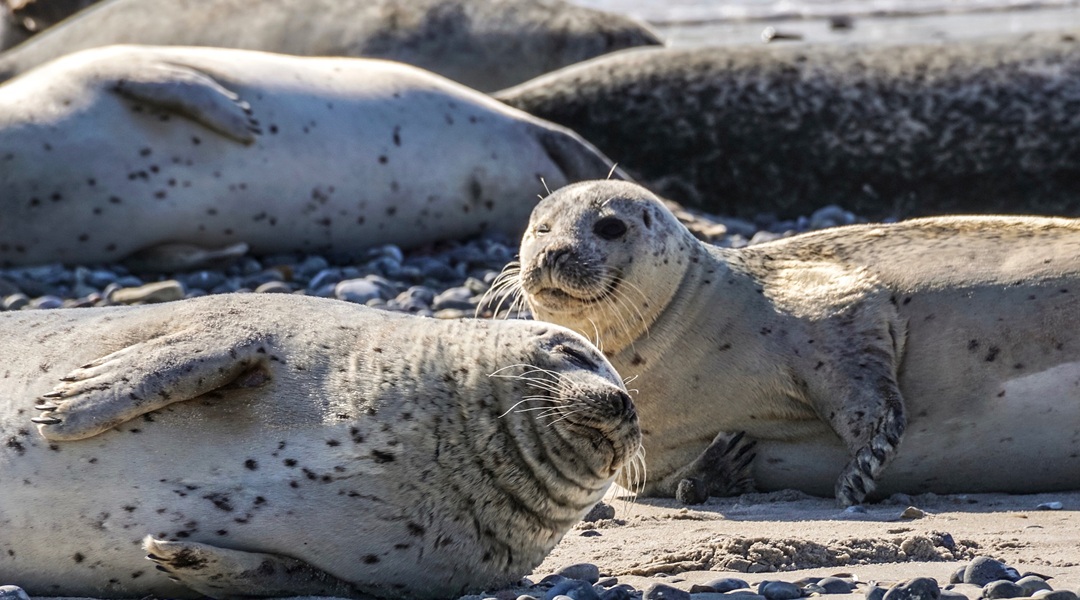
Millions of years after their land-dwelling ancestors first ventured into the ocean, seals, sea lions and walruses still haul out onto beaches and ice. New research finds that, as these animals adapted to aquatic life, their vertebral columns were reshaped to favor streamlined swimming and powerful propulsion, with flexible lower backs being preferred to the mobile necks their terrestrial relatives rely on for running and feeding.
Marine animals with flippers, such as seals, walruses and sea lions, are called pinnipeds. Several million years ago, the ancestors of these marine creatures lived on land. Related to raccoons, skunks, and weasels, the ancestors of present-day pinnipeds spent longer amounts of time in the ocean, and evolved to prefer the ocean environment, even though they still come on land today.
In previous research, Borja Figueirido, a researcher at the Universidad de Málaga, Spain, and colleagues explored how the vertebral column changed as some flesh-eating animals moved from land to water, with the fluidity of their new environs permitting freer movements. But these earlier studies didn’t directly test what changes to the vertebral column actually do, in terms of spinal motion and flexibility.
For this study, the team measured the osteological range of motion (oROM) of the intervertebral joints of the cervical, thoracic and lumbar regions of pinnipeds and, for comparison, those of terrestrial and semi-aquatic carnivores. They were hoping to explore how spinal mobility would relate to swimming, terrestrial motion or feeding behaviors.
To begin with, the researchers measured oROM for 23 species, using adult skeletons housed in museums across North America and Europe. After extensive imaging and 3D reconstructions of vertebral columns, they ultimately used Autobend, a protocol for quantifying mobility of the spine across various planes. When movement across these planes is in sync, spinal motion is more stabilized. On the other hand, when motion across these planes is less coordinated, different parts of the spine may move more independently.
The researchers found that, as animals moved from land to sea, their spines became more flexible, to support swimming. Terrestrial carnivores have stiffer mid and lower backs that help support their weight while running. Their flexible necks allow for more maneuverability when feeding on prey. Semi-aquatic species fall somewhere in between terrestrial carnivores and pinnipeds, with slightly more flexibility in their lower spine compared to stiff-backed terrestrial carnivores.
The researchers found that pinnipeds overall are more mobile in their lower back or lumbar region, while their cervical mobility is reduced, possibly since they do not depend much on head movements. A stiffer neck likely allows the pinniped to maintain a more streamlined form ideal for swimming, with reduced drag, while a more flexible lower spine helps it to powerfully propel through the water, undulating and turning rapidly.
Different pinnipeds have varying spinal mobility, suited to their swimming and feeding styles. Sea lions have more flexible spines, particularly along the neck and lower back, with stiffer spines along the chest, favoring more agility. Seals have more rigid spines along the chest and back, with more mobility in their lower back, allowing for more propulsion through the water. Walruses have limited cervical mobility, but more flexibility along their chest and back.
“Our results demonstrate that the land-to-sea transition in carnivorans involved a shift in intervertebral joint mobility. Terrestrial taxa show reduced mobility in the thoracic and lumbar regions, but increased cervical mobility, likely linked to prey handling on land,” write the researchers. “In contrast, pinnipeds exhibit greater vertebral mobility overall, particularly in the lumbar region, probably reflecting their role in propulsion (i.e., phocids) and maneuverability (i.e., otariids) in water. However, pinnipeds show reduced cervical mobility, which likely reflects a combination of reduced need for prey manipulation and adaptations for streamlined swimming.”
Reference: Juan Miguel Esteban et al., Patterns of spinal motion, kinematic spaces and the land-to-sea transition in carnivorans, The Anatomical Record (2026). DOI: https://doi.org/10.1002/ar.70102
Featured Image via Pixabay, Editor’s Choice (no creator’s name provided)