Using magnetic resonance imaging (MRI), scientists have developed personalized, whole-brain computational models of patients with disorders of consciousness. Using these models to create ‘digital twins’, the effect of psychedelics on brain activity can be simulated without physical administration of the drug.
“We found that simulated psychedelics shifted brain dynamics toward a more flexible regime which is associated with increases in consciousness,”explains Naji Alnagger, PhD candidate at the University of Liège and lead author of this research.
“This work carries significant ethical and logistic challenges due to the sensitive nature of the patients and the legal status of the drugs. Therefore, running computational models of such experiments may provide a first step to better understand how such a treatment may work theoretically, and better prepare researchers that may wish to engage in the work experimentally.”
The realm of consciousness
Scientists still do not fully understand why we experience consciousness. What is known is that physical brain structure (the wiring of the brain via white matter connectivity) and neural function are determinants of consciousness.
Disorders of consciousness (DOC) are divided into two different states: unresponsive wakefulness syndrome and a minimally conscious state. In a state of unresponsive wakefulness, a person has periods of wakefulness and reflex action capability but is unresponsive; in a minimally conscious state, a person responds to commands and has eye co-ordination, but is unable to communicate.
DOC can arise from severe brain injury, causing a coma (state of reduced consciousness). In this state, the brain does not integrate information and is marked by a low complexity of activity. Under anesthesia, the brain also operates at a lower level of complexity, lacking the ability to integrate information. For this reason, brain images from healthy people under anesthesia also contributed to computational models in this study.
Research on the utility of psychedelics to treat psychological disorders of mood and emotions is growing, and studies show psychedelics cause the brain to operate at a higher level of complexity and at the edge of what is known as criticality. Criticality is defined as the point where a system, in this case the brain, transitions from order to disorder; it is at this point where information is most efficiently processed in the brain. It follows that, in disorders of consciousness, these drugs could shift brain dynamics from lower to higher complexity, closer to criticality and a healthy state. However, ethical and legal challenges to this research exists, including the inability of such patients to consent or communicate any negative effects, and there is also debate about what constitutes a positive outcome.
Virtual clinical trials in psychedelic drug research
Exploring this are a multidisciplinary team of researchers from the University of Liège, Belgium, collaborating with other institutes across Europe. Alnagger explains how they conducted a virtual ‘phase zero’ clinical trial to assess the effects of two psychedelic drugs, LSD and psilocybin:
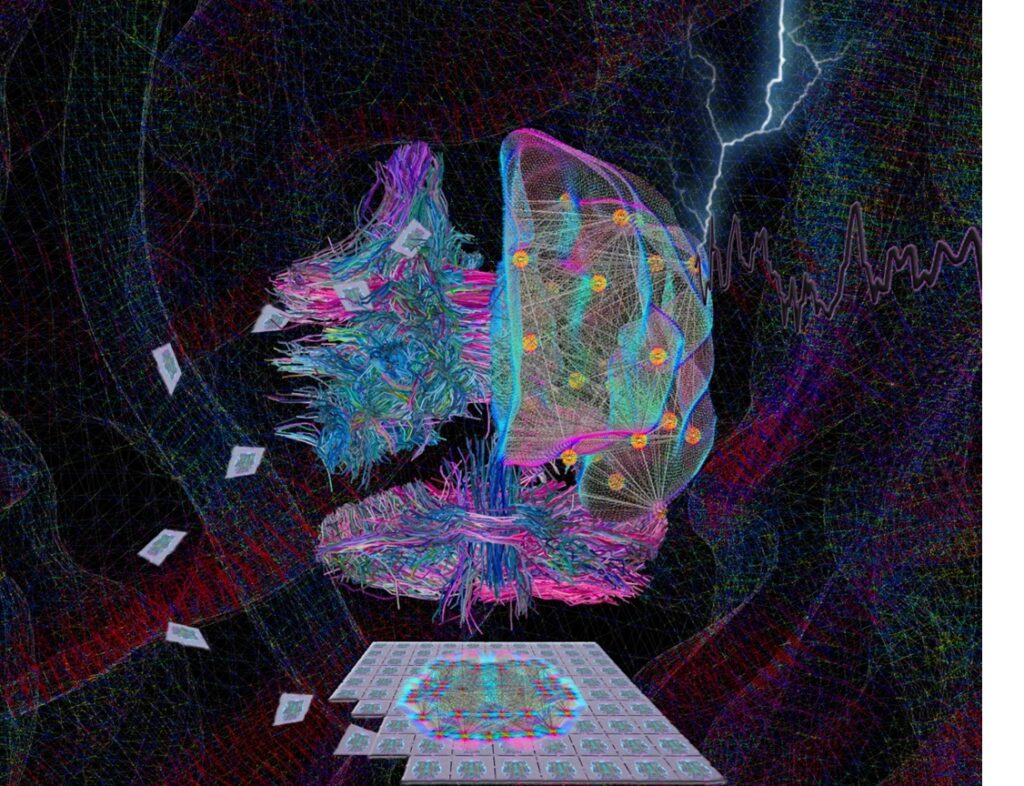
“We used patient functional MRI data (the blood flow in the brain at rest), and patient diffusion MRI data (the white matter structural wiring of the brain), to build personalized digital twins of patients with a disorder of consciousness.”
“We first validated that the models could distinguish between different states of consciousness, such as wakefulness, anesthesia, and psychedelic states, by measuring how the simulated brain responded to brief simulated perturbations.” They then used data from healthy people under psychedelics to quantify its effects on the brain.
This enabled the drug effect to be simulated in brain models of DOC without physically administering psychedelics. By analyzing brain dynamics before and after this psychedelic simulation, the team gained insight into ‘treatment effects’. They found that psychedelics can shift the brain dynamics of people with DOC closer to criticality and into a state associated with increased consciousness, with more profound effects noted in minimally conscious patients compared to those with unresponsive wakefulness syndrome.
Furthermore, they found that brain structure is more of a determinant of simulated treatment response in unresponsive patients, while in minimally conscious patients, functional connectivity(different areas of the brain working together to aid cognitive function) determines this.
“This points to the idea that the physical brain damage in patients with disorders of consciousness is the limiting factor in this treatment,” remarks Alnagger. “Since it’s currently not possible to regrow brain tissue, if brain structure is a limiting factor for other treatments, it suggests an unfortunate outlook for unresponsive patients with severe brain damage.”
Breaking new ground
Much work is needed to move this research forward. The team says the fundamentals of the models need improvement, so they more accurately simulate brain activity. While the study is a vital first step towards understanding the potential of psychedelics in disorders of consciousness, providing a theoretical proof-of-principle, it cannot conclusively prove that psychedelics boost consciousness because it is a virtual clinical trial and not real-world experimentation.
“It’s important to note that it may be possible that psychedelics may induce a state which does not ‘improve’ consciousness. Whether psychedelics might result in new behaviours that signify consciousness, an increase in conscious experience, or none of the above remains an open question,” notes Alnagger.
To determine this, real-life clinical trials are needed but, due to the aforementioned ethical and legal challenges, any such groundbreaking trials are not currently planned.
In this study, the team used computational modelling to specifically develop digital twins for virtual testing of psychedelics on the brain. However, computational modelling has other applications and is increasingly utilized in personalised medicine. Speaking about these possible utilities in drug discovery and personalised medicine, Alnagger notes: “The principles of such an approach could be employed in far future daily practice to select the best treatment for a particular patient, or in a pre-clinical drug discovery tool to test treatments that could be taken forward to clinical trials.”
References
N. L. N. Alnagger et al., A Virtual Clinical Trial of Psychedelics to Treat Patients With Disorders of Consciousness, Advanced Science (2025), DOI: 10.1002/advs.202511780
P. Cardone et al., Psychedelics and disorders of consciousness: the current landscape and the path forward, Neuroscience of Consciousness (2024), DOI: 10.1093/nc/niae025
Featured image credit: Dierk Schaefer via Flickr, CC-BY 2.0