Breakthrough technology AlphaFold could help scientists revolutionize crop breeding through precision gene editing. A team collaborating across China and the US utilized the AI program AlphaFold’s protein structure predictions to guide CRISPR–Cas9-based gene editing of two soybean sugar transporter genes, GmSWEET10a and GmSWEET10b.
Soybeans with more oil are useful because they help produce more food products, fuel, and other materials (for example, see here how it’s being used in the energy industry). Their higher oil content also improves seed quality and germination. GmSWEET10a, naturally selected during soybean domestication for its role in increasing seed size and oil content, was found to have C-terminal variants that influence its sugar transport efficiency. Led by Jie Wang and Yuefeng Guan, the researchers used AlphaFold to identify structural differences between high-oil (HO-type) and low-oil (LO-type) variants. They then engineered HO-mimic mutations in GmSWEET10a, resulting in increased oil content in greenhouse trials.
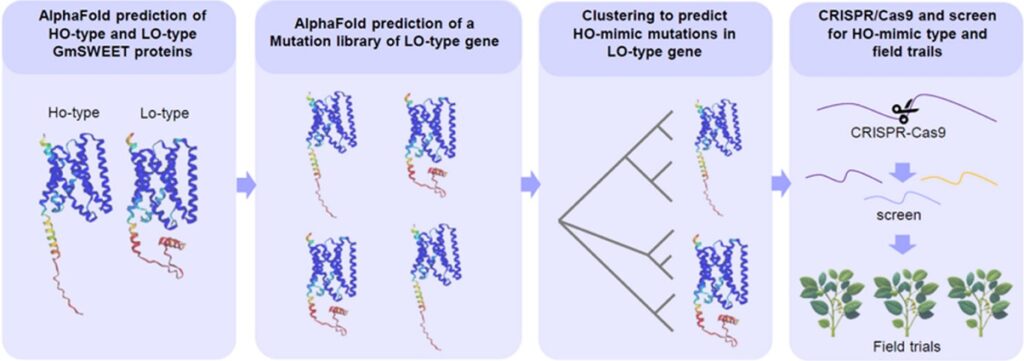
Significantly, the team was able to create novel haplotypes with enhanced sugar transport capabilities for GmSWEET10b – a functionally similar but naturally unselected gene. The HO-type mutations facilitated greater sugar allocation to embryos, underpinning the observed oil increase. However, the engineered LO-type variants of GmSWEET10b led to increased protein content, confirming a trade-off between these two traits for these genes.
Multi-year, multi-location field trials have confirmed that the edited soybeans consistently show increased oil and protein content, without compromising yield.
This pioneering approach not only marks a significant step toward improving soybean quality and securing food resources but also exemplifies how AI can be harnessed to meet global food and nutritional demands. Such gene-edited lines offer a promising path towards sustainable agricultural innovation.
Reference: Jia Wang et al., AlphaFold-Guided Bespoke Gene Editing Enhances Field-Grown Soybean Oil Contents, Advanced Science (2025). DOI: 10.1002/advs.202500290
Featured image: Melquizedeque Sousa via Pixabay