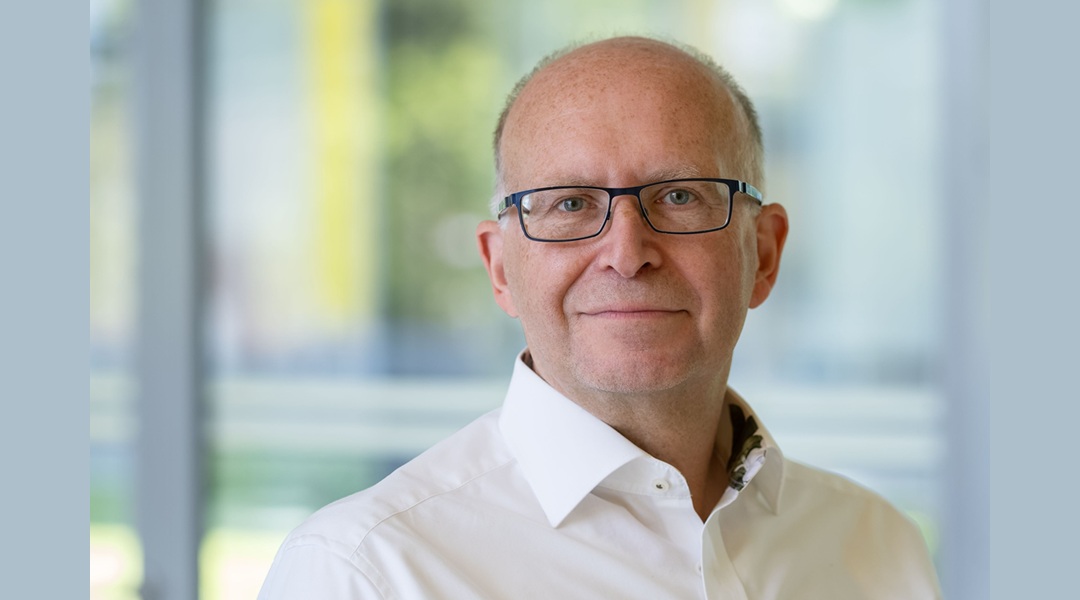
Jürgen Janek is a professor and group leader at Justus-Liebig University Giessen and a spokesperson for the successful Post-Lithium Storage Cluster of Excellence alongside Helmut Ehrenberg (KIT) and Birgit Esser (Ulm University). This program was recently granted a new seven-year funding period (from 2026 until the end of 2032) as part of the ‘Excellence Strategy’ of the Federal and State Governments of Germany, indicating the promise and critical importance of this research.
Few career paths are a straight line: when I asked Professor Janek how he got into this field and where he sees it going, he informed me that he had almost chosen to study history instead. Luckily for the electrochemistry community, he enrolled in chemistry and some notable gaps in our knowledge drew him in and kept him there…
Your group focuses on the electrochemistry of solids. What got you interested in this area? Was there someone who especially influenced your early career and thinking?
What attracted my interest very early were the missing chapters in electrochemistry textbooks. I studied chemistry from 1983 till 1989 in Hannover in Germany, and my academic teachers Hermann Schmalzried, Klaus Funke and Manfred Martin had a strong background in physics, metallurgy and materials science. Later, Alan B. Lidiard (Harwell, Oxford) had a strong influence on my work during a long-term collaboration; he was an expert in transport theory and wrote the first chapter on ionic conduction in the solid state in the ‘Handbuch der Physik’ [Handbook of Physics]. I learned a lot on defects in solids, ion transport and reactions in the solid state in the 1990s – which was rarely covered in most chemistry textbooks. I believed that solid-state electrochemistry, internationally known as solid-state ionics, would be an excellent field at the crossings of chemistry, physics and engineering. I also thought that this field would be very important for energy technologies, which has proven to be true.
What do you think was the most important scientific discovery or achievement in this area over the last 10 years?
Spontaneously, I think that Ryuichi Kanno’s report on very high lithium-ion conductivity in the sulfide compound Li10GeP2S12 (“LGPS”) in 2011 (Nature Materials) was a major trigger for the fast rise of solid-state battery concepts. The reliable and reproducible demonstration of lithium-ion conductivity higher than 10 mS/cm—which is higher than [that] of typical liquid electrolytes—quickly inspired many researchers worldwide and led to a productive competition for novel solid electrolytes that has not ended yet. Recent reports and results for sodium solid electrolytes let me hope that room-temperature conductivities even above 100 mS/cm might be achieved. That could open novel pathways toward more sustainable, high-power solid-state batteries.
“Recycling has to be included into the design of novel materials and cell concepts from the very beginning.”
Your group is part of the POLiS program – the Post-Lithium Storage Cluster of Excellence – which has just received a funding extension of 7 years. Could you tell us, what does this program support, and what are its ultimate goals?
The POLiS cluster, which will, in its second funding period from 2026 on, be run jointly by University of Ulm, Karlsruhe Institute of Technology and Justus-Liebig University Giessen (all Germany), focuses on fundamental research on energy storage cell concepts that rely on mobile ions ‘beyond’ or ‘post’ lithium. Well, as lithium-based batteries for sure will always be used in the future, this means to explore cell concepts based on other monovalent cations like sodium or potassium ions, multivalent magnesium, calcium or aluminium ions, or even anions like chlorine ions. Clearly, sodium-ion batteries will make their way, but the prospect of other cell concepts has yet to be fully explored. In particular, multivalent ions pose many challenges that lie in their high charge and the resulting interaction with their surroundings. Effectively, POLiS aims to add more feasible options for electrochemical storage in the future. [Its] ultimate goal is to increase the future fraction of storage in cells with mobile ions beyond lithium. I am convinced that more diversity of well-functioning cell concepts with different cell chemistries will offer energy storage technologies that are more resilient [to] geo-political fluctuations.
What are your own group’s contributions to the program? Is there a contribution in particular you’re most proud of?
My group contributes mostly solid-state concepts, as well as in-depth studies of interface reactions and charge transport and transfer. Recent work I am quite proud of is part of the PhD project of Till Ortmann within POLiS. Together with another PhD student, Till Fuchs, he managed to image and analyse the microstructure of sodium metal (along with lithium metal) through electron backscatter diffraction. This work (Nature Materials, 2024; Adv. Energy Mater., 2023 and 2024) opened new perspectives for the design of metal anodes in batteries. Other results I am particularly proud of originate from the PhD project of Clarissa Glaser within POLiS. She synthesized and characterized novel magnesium-ion solid electrolytes on the basis of selenide spinels. Her results (e.g., Adv. Energy Mater., 2023 and 2024) show that magnesium-ion conductivities can enter the 0.1 mS/cm region, offering novel opportunities for full cells.
What is the importance of recycling with regard to POLiS technologies?
POLiS, in its new configuration from 2026 on, will have its own extended research area on sustainability, including systematic work also on recycling issues. We believe that later recycling has to be included into the design of novel materials and cell concepts from the very beginning.
What do you believe will be the fourth gigawatt-scale technology after Pb, Li, and Na?
Well, research is fortunately not about ‘belief’ but rather about expectations substantiated by proper scientific results. Anyhow, it is not easy to predict later success of findings that typically occur on the academic lab scale. There are so many techno-economic and engineering factors that decide whether a novel battery cell chemistry can [become] ‘practical’ and a large-scale technology. Once sodium-ion batteries [are] successful at the markets, a major step has been achieved. Whether any other ‘beyond Li and Na’ cell chemistry can be added as GWh technology will depend on its performance and specific advantages. POLiS explores a number of mobile ions (K, Mg, Ca, Al, Cl) as [the] basis for other cell chemistries, and we hope that one of them can, at the end, open new opportunities in practice.
“What I would like to see more is active discussion and commenting of published manuscripts, and perhaps even the option to modify or improve published papers.”
What are your thoughts on scientific communication and reporting in your field?
Well, this is a wide field, and this is a subject that becomes even more critical in times of AI. First of all, scientific results need to be communicated – otherwise science will not advance. Reliability, credibility and reproducibility are key criteria for good scientific communication. I think that scientific societies, and not only publishers, need to take more responsibility for high-quality reporting. I know that there is continuous discussion on the future of publishing, and I take my part in that. I prefer open access publication in journals with a transparent and rigid quality control. What I would like to see more is active discussion and commenting of published manuscripts, and perhaps even the option to modify or improve published papers. My feeling is that today´s publications still follow the old rules from printing true papers, where of course no further change was possible. Today, we have other tools, and we may need to develop more advanced types of ‘living documents’.
What do you enjoy doing when you aren’t working?
I almost started studying history when entering university. But then I decided on chemistry, simply for pecuniary reasons. However, I kept my strong interest in history and historical developments. So, traveling and exploring historical sites, libraries and museums (here also for art!) is fun for me. Otherwise, I love to cook and expand my knowledge on wine, often connected with hiking tours in those regions in Europe where wine is being produced. And I always have a guilty conscience not doing enough sports.
Featured Image: Prof. Dr. Jürgen Janek, Physikalische Festkörperchemie – Festkörperionik und Elektrochemie, Justus-Liebig-Universität Gießen. Photo credit: Rolf K. Wegst