Modern agriculture is facing a paradoxical crisis: we need to produce more food than ever before, yet the tools we use to protect that food are slowly destroying the environment it grows in. Every year, fungal pathogens wipe out nearly 40% of global crop yields, a devastating loss that threatens food security. For the last century, the only scalable answer has been the widespread application of synthetic pesticides. While effective in the short term, this approach has created toxic feedback: overuse pollutes soil and waterways, harms biodiversity, and drives the evolution of fungicide-resistant super-strains, forcing farmers to use ever stronger chemicals.
Compounding this struggle is the reality of a rapidly changing climate. Crops today must withstand not just pests and diseases, but also longer droughts, intense heatwaves, and higher levels of ultraviolet (UV) radiation. With global initiatives like the European Green Deal aiming for a 50% reduction in chemical pesticide use by 2030, the agricultural world is desperate for novel strategies.
To find a sustainable alternative, a team of international researchers decided to stop inventing new poisons and instead study the plants themselves.
Emulating Nature’s defenses
Many plants, famously including the lotus, defend themselves using a waxy cuticle that repels water and removes pathogens through self-cleaning. Inspired by these superhydrophobic surfaces, the researchers developed a new bio-based, spray-on coating that recreates the protective functions of natural plant wax layers.
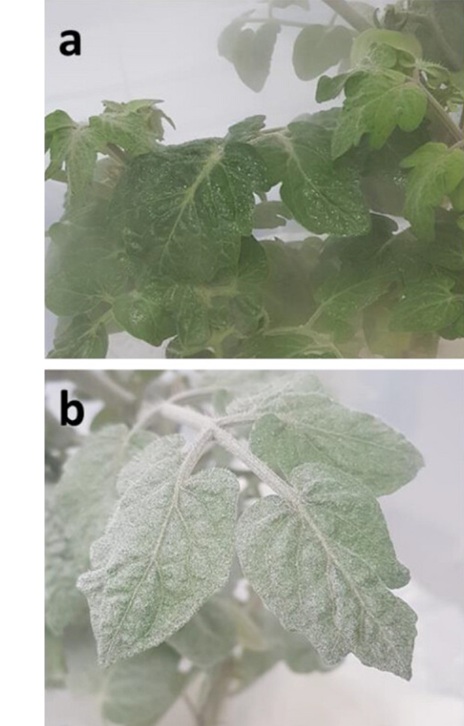
Their ‘SafeWax’ coating, introduced in Small, uses crystalline fatty acids to spontaneously form micro- and nano-structured superhydrophobic layers when sprayed onto a plant surface.
When the team tested their coating on crops like tomatoes and grapevines, which naturally allow water to spread and adhere to their leaves, SafeWax transformed their surfaces into super-repellent shields. Microscopic imaging revealed the secret: the coating covered the foliage with dense, fractal-like wax crystals. Emulating natural wax nanostructures, this texture creates a rough surface that physically blocks water accumulation, preventing the formation of the wet environment that pathogens require to survive.
In addition to limiting moisture retention and preventing pathogen adhesion, SafeWax functions as a passive barrier to enhance UV and heat resilience, its crystalline structure acting as a natural sunblock against damaging UV radiation. It possibly also helps plants to harvest water from dew by channeling droplets to the soil in humid conditions.
Protection without poison
This fresh approach to crop protection is grounded not in chemistry, but in structure and materials design.
Unlike chemical treatments, SafeWax remains on the surface, ensuring eco-friendly protection without penetrating the plant or introducing harmful residues into the ecosystem. Thus, SafeWax introduces a novel principle that avoids the toxicity of traditional pesticides by creating a physical barrier that offers agronomic benefits far beyond just disease control.
While the current study establishes the concept and feasibility, the authors outline several challenges ahead: optimizing large-scale formulation, assessing long-term ecological impact, refining solvent-free approaches, and determining real-world reapplication cycles. Future research will also explore whether SafeWax can be integrated with organic farming practices or paired with reduced pesticide doses for hybrid strategies.
Beyond agriculture, the coating’s ability to prevent adhesion and biofilm formation suggests potential applications in marine surfaces, architecture, and other industries where controlling moisture and fouling is essential.
Reference: I. Polishchuk et al., SafeWax: A Bio-Inspired Multifunctional Coating for Sustainable Crop Protection, Small (2025), DOI: 10.1002/smll.202505360
Featured image credit: StockSnap via Pixabay