Researchers at Peking University have designed an artificial pancreas 98% smaller and 100 times cheaper to manufacture than any of the devices currently available in the market.
An artificial pancreas is an automated insulin delivery system consisting of a sensor that continuously tracks blood sugar levels, an insulin pump, and an algorithm that calculates how much insulin is needed at any given moment. This type of device can significantly improve the management of diabetes — both type 1 and type 2 — as it shifts the burden of making treatment decisions multiple times a day away from the patients.
However, these devices are bulky, uncomfortable to wear, and the long needle required for the blood glucose sensor can cause pain in some users. In addition, the price of this technology is currently a major barrier preventing widespread use.
“To date, there are only a few commercially available artificial pancreas devices on the market,” said Yue Cui, associate professor at Peking University’s School of Materials Science and Engineering. “These devices are expensive, ranging from $3,000 to $8,000.”
In contrast, the new artificial pancreas designed by Cui and colleagues is compact, easy to wear and inexpensive to manufacture at a cost of $10 per unit.
How to build a mini artificial pancreas
The first step to make the miniature artificial pancreas was to reduce the size of the glucose sensor. To that end, the researchers switched the long metal needle used in commercial devices with microneedles less than 1 mm long each, that dissolve away once they are no longer needed. Upon application, the needles pierce the top layer of the skin just enough to put in place an array of even smaller microtubes, attached to electrodes that the sensor relies on to measure glucose levels.
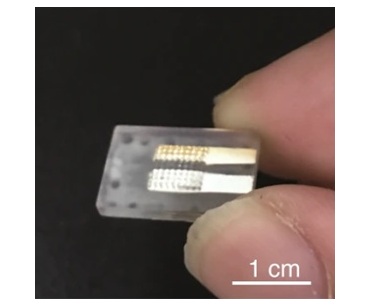
Another crucial step towards reducing the overall size of the device was to lower its power consumption, since the batteries required to power it take up a sizeable portion of the system. Because the insulin pump is the component that consumes the most energy, the scientists switched the traditional mechanical pump for an electro-osmotic micropump, which is much smaller and simpler. The micropump was further engineered to reduce the amount of energy it consumes, resulting in a total power usage more than 300 times lower than a conventional insulin pump.
The glucose sensor, the micropump and a 3D-printed insulin reservoir were then stacked on top of each other, resulting in a device the size of a small coin — about 1.5 cm in diameter and 1cm thick. The total volume of the device is just about two cubic centimeters, while a typical artificial pancreas currently available is often more than 100 cubic centimeters big.
Increasingly accessible technology
Experiments in diabetic rats and pigs showed the miniature artificial pancreas could maintain stable glucose sensing and insulin pumping over the course of three days. On average, the animals had their blood sugar levels in the target range 68% of the time, compared to 75% time in range for a commercial device.
Based on typical profit margins and cost of sales for medical devices, the researchers estimate that about 40% of the price of commercial devices are manufacturing costs, which would put these expenses at between $1,000 to $4,000 per device. At just $10 per unit, the manufacturing costs of the miniature artificial pancreas could make this technology much more accessible to users across the world.
Future work will focus on improving the performance of the device while further reducing its size and power usage. In order to prepare the device to be used in a clinical setting, the scientists will also work on improving the control algorithms that calculate how much insulin is required at any given moment, as well as making the smartphone interface more user friendly.
“Considering all these optimized processes and the time needed for FDA approval, it is estimated to be 3–5 years for the device to be practically used in the future,” said Cui. “We expect that this work would offer important contributions to digital health and wearable devices for diabetes patients, and have the potential to revolutionize conventional diabetes management toward at-home healthcare.”
Reference: Yiqun Liu et al., Closed-Loop Bioelectronic Artificial Pancreas Patch for Continuous Monitoring and Regulation of Blood Glucose in Diabetic Rats and Pigs, Advanced Science (2025). DOI: 10.1002/advs.202503536